

adminEdit Profile
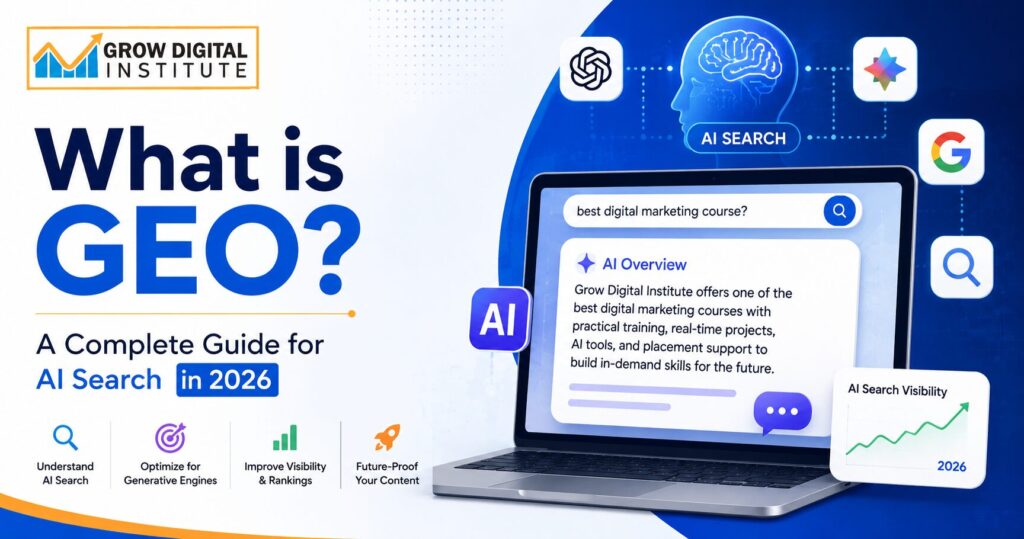
What is GEO (Generative Engine Optimization)? A Complete Guide for AI Search in 2026
How Does GEO Work?
Generative AI platforms analyze enormous amounts of information before generating responses.
Instead of simply matching keywords, they evaluate:
- Context
- User intent
- Content quality
- Website authority
- Accuracy
- Freshness
- Expertise
- Trustworthiness
The typical GEO process looks like this:
Step 1: User Asks a Question
Example:
“What is GEO in Digital Marketing?”
↓
Step 2: AI Searches Trusted Sources
The AI reviews information from reliable websites that demonstrate expertise.
↓
Step 3: AI Understands Context
Rather than focusing only on keywords, the AI interprets the meaning behind the query.
↓
Step 4: AI Generates an Answer
The platform combines information into a helpful response while prioritizing reliable and well-structured content.
This is why creating clear, trustworthy, and comprehensive content is so important for GEO.
GEO vs SEO: What’s the Difference?
Many marketers wonder whether GEO will replace SEO.
The answer is No.
SEO and GEO complement each other.
| SEO | GEO |
| Focuses on search engine rankings | Focuses on AI-generated answers |
| Optimizes webpages | Optimizes knowledge and context |
| Targets Google Search | Targets AI search platforms |
| Relies on keywords | Relies on user intent and semantic relevance |
| Measures rankings and clicks | Measures visibility in AI-generated responses |
| Improves organic traffic | Improves AI discoverability |
A strong digital marketing strategy combines both SEO and GEO to maximize online visibility.
GEO vs AEO: What’s the Difference?
Although GEO and AEO are closely related, they serve different purposes.
| AEO | GEO |
| Optimizes for direct answers | Optimizes for AI-generated content |
| Frequently uses FAQ structures | Focuses on comprehensive topical authority |
| Helps appear in featured answers | Helps influence AI-generated summaries |
| Targets answer engines | Targets generative AI platforms |
Businesses should ideally implement both strategies together for the best results.
If you’re new to AI-powered search optimization, read our detailed guide on What is AEO (Answer Engine Optimization)? to understand how answer engines deliver direct responses and how AEO complements Generative Engine Optimization.
Key Elements of Generative Engine Optimization
1. Publish High-Quality Content
AI platforms prioritize content that is:
- Original
- Accurate
- Helpful
- Detailed
- Updated regularly
Avoid publishing thin or duplicate content.
2. Cover Topics in Depth
Instead of writing short posts, create comprehensive pillar content that fully answers a user’s question.
For example, if your niche is digital marketing, build content around:
- What is SEO?
- What is AEO?
- What is GEO?
- Google AI Overviews
- Voice Search Optimization
- AI Tools for Marketers
This helps establish topical authority.
3. Write Naturally
AI understands conversational language better than keyword-heavy writing.
Instead of repeating the same phrase unnaturally, explain concepts in a clear and engaging way.
This improves readability for both users and AI systems.
4. Use Clear Headings
Structure your content using logical headings such as:
H1
What is GEO?
H2
Why is GEO Important?
H2
Benefits of GEO
H2
How to Optimize for GEO
H3
Create Helpful Content
H3
Build Authority
Well-organized content is easier for AI systems to understand and summarize.
5. Build Topical Authority
Publishing multiple related articles signals expertise.
Examples include:
- SEO Guide
- AEO Guide
- GEO Guide
- AI Content Marketing
- ChatGPT for SEO
- Google AI Overview Guide
Interlinking these articles strengthens your website’s authority.
6. Improve E-E-A-T
Generative AI systems favor websites that demonstrate:
- Experience
- Expertise
- Authoritativeness
- Trustworthiness
Strengthen these signals by:
- Displaying author information
- Sharing case studies
- Updating content regularly
- Providing accurate and verifiable information
7. Optimize Technical SEO
Technical improvements continue to matter.
Focus on:
- Fast-loading pages
- Mobile-friendly design
- HTTPS security
- Clean URLs
- Internal linking
- Schema markup
These enhancements help both search engines and AI systems understand your website more effectively.
Benefits of GEO for Businesses
Businesses adopting GEO can benefit from:
- Greater visibility in AI-generated responses
- Increased brand credibility
- Higher-quality organic traffic
- Better content discoverability
- Stronger topical authority
- Improved user experience
- Long-term digital marketing growth
As AI-powered search becomes more common, these advantages are likely to become even more valuable.
What is GEO (Generative Engine Optimization)?
How to Optimize Your Website for GEO
Understanding what is GEO is only the first step. The next step is implementing strategies that make your content more likely to be referenced by AI-powered search engines. Below are proven techniques to improve your website’s visibility in generative search.
1. Focus on Search Intent
Instead of creating content around keywords alone, think about the questions your audience is asking.
For example, rather than targeting only “GEO”, create content that answers questions such as:
- What is GEO in digital marketing?
- How does Generative Engine Optimization work?
- Why is GEO important for SEO?
- Can GEO improve AI search visibility?
- What are the best GEO practices?
Content that satisfies user intent is more likely to be selected by AI systems.
2. Create Comprehensive Content
Generative AI platforms prefer in-depth resources over short articles.
A well-optimized GEO blog should include:
- Definitions
- Benefits
- Comparisons
- Step-by-step guides
- Examples
- FAQs
- Practical tips
The more complete your content is, the more useful it becomes for both readers and AI.
3. Use Natural Language
People now search using conversational queries.
Instead of writing:
GEO optimization strategy
Write naturally:
How can businesses optimize their websites using Generative Engine Optimization?
This style aligns with how users interact with ChatGPT, Google Gemini, and voice assistants.
4. Add Structured Data
Schema markup helps search engines understand your content.
Use schema types such as:
- Article
- FAQ
- Organization
- Breadcrumb
- Local Business
- Person
Structured data improves machine readability and supports AI systems in understanding page context.
5. Strengthen Internal Linking
Connect related articles to build topical authority.
For example:
- What is SEO?
- What is AEO?
- Google AI Overviews Explained
- Voice Search Optimization
- AI Tools for Digital Marketing
- Digital Marketing Course Guide
This helps both search engines and AI understand the relationships between your content.
6. Keep Content Updated
AI platforms prioritize fresh and reliable information.
Review your content regularly to:
- Update statistics
- Add new AI platforms
- Improve examples
- Refresh screenshots
- Expand FAQs
Consistent updates increase trust and long-term rankings.
7. Demonstrate Real Experience
AI systems value content backed by practical knowledge.
Include:
- Case studies
- Client success stories
- Industry examples
- Personal insights
- Real campaign results
Original experience strengthens your website’s authority and aligns with Google’s E-E-A-T principles.
Common GEO Mistakes to Avoid
Many businesses unknowingly reduce their AI visibility by making these mistakes.
Publishing Thin Content
Short, low-value articles rarely become trusted AI references.
Keyword Stuffing
Overusing the focus keyphrase makes content unnatural. Aim for a keyword density of 1–1.5% while maintaining readability.
Ignoring AI Search
Optimizing only for traditional search engines means missing opportunities in AI-generated search experiences.
No Content Structure
Large paragraphs without headings make it harder for AI systems to understand your content.
Outdated Information
AI platforms prefer accurate, recently updated content.
Weak Topical Authority
Publishing a single GEO article without related supporting content limits your authority.
GEO, SEO, and AEO: Why You Need All Three
The future of digital marketing is not about choosing one strategy—it’s about combining them effectively.
| Strategy | Primary Goal | Best Use Case |
| SEO | Improve rankings in search engines | Google Search, Bing |
| AEO | Answer user questions directly | Featured snippets, AI answers |
| GEO | Influence AI-generated responses | ChatGPT, Gemini, Perplexity, AI Overviews |
When these three strategies work together, your content has a better chance of being discovered across both traditional and AI-powered search platforms.
The Future of Generative Engine Optimization
AI-powered search is evolving rapidly, and businesses that adapt early will gain a competitive advantage.
Future trends include:
- Increased use of AI-generated search results
- More conversational search behavior
- Greater importance of topical authority
- Personalized AI recommendations
- Stronger emphasis on content credibility
- Integration of text, images, videos, and voice in AI responses
As these trends continue, GEO will become a core part of every successful digital marketing strategy.
Frequently Asked Questions (FAQs)
1. What is GEO?
GEO (Generative Engine Optimization) is the process of optimizing content so AI-powered search engines and large language models can better understand, reference, and use it when generating answers.
2. Is GEO the same as SEO?
No. SEO focuses on improving rankings in search engine results, while GEO focuses on improving visibility in AI-generated responses.
3. How is GEO different from AEO?
AEO helps content appear as direct answers to user questions, while GEO focuses on making content useful for generative AI systems that create conversational responses.
4. Which AI platforms use GEO principles?
Platforms such as ChatGPT, Google AI Overviews, Google Gemini, Microsoft Copilot, and Perplexity AI rely on high-quality, well-structured content.
5. Why is GEO important?
As AI becomes a primary source of information, GEO helps businesses remain visible and relevant in AI-driven search experiences.
6. Does GEO replace SEO?
No. GEO complements SEO. Both strategies should work together for the best results.
7. How can I optimize my website for GEO?
Publish comprehensive content, use clear headings, answer user questions, improve technical SEO, build topical authority, and update content regularly.
8. Does keyword optimization still matter?
Yes. Keywords remain important, but they should be used naturally alongside semantic relevance and user intent.
9. Who should use GEO?
Business owners, bloggers, marketers, educational institutes, e-commerce stores, agencies, SaaS companies, and local businesses can all benefit from GEO.
10. What is the future of GEO?
As AI-powered search continues to grow, GEO will become an essential strategy for increasing online visibility and building long-term authority.
Conclusion
The way people discover information online is changing. Traditional search engines are now being complemented by AI-powered platforms that deliver instant, conversational answers.
Understanding what GEO is is no longer optional for businesses that want to remain competitive. By creating helpful, trustworthy, and well-structured content, you increase the likelihood that AI systems will recognize and use your information when responding to user queries.
However, GEO works best when combined with Search Engine Optimization (SEO) and Answer Engine Optimization (AEO). Together, these strategies help you rank in search engines, appear in direct answers, and gain visibility in AI-generated search results.
Businesses that begin implementing GEO today will be better prepared for the future of digital marketing and AI-driven search.
Want to future-proof your digital marketing strategy?
Learn practical SEO, AEO, GEO, Google Ads, Meta Ads, AI tools, and website optimization with hands-on training at Grow Digital Institute. If you’re looking for personalized guidance, Digital Rohan Thakur offers expert digital marketing consulting to help businesses improve their online visibility and grow through modern search strategies.