
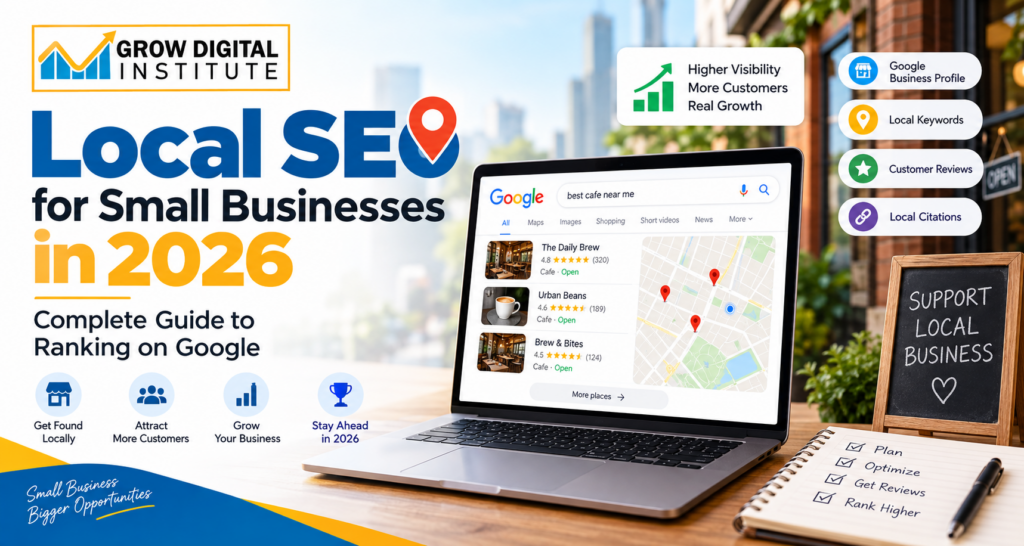
Local SEO for Small Businesses in 2026: Complete Guide to Ranking on Google
For a small business, being visible when people search for products or services in your area can make a major difference. A customer looking for a dentist, restaurant, salon, diagnostic centre, coaching institute, freelancer or local service provider is often ready to take action.
This is where local SEO for small businesses becomes important.
Local SEO helps businesses improve their visibility in location-based searches on Google Search and Google Maps. A well-optimized Google Business Profile, relevant local keywords, positive reviews, useful website content and strong local signals can help your business appear in front of people who are actually looking for what you offer.
In 2026, local search is also becoming more competitive. Customers are using Google Maps, traditional Google Search and increasingly AI-powered search experiences to discover businesses.
The good news is that local SEO does not require a huge marketing budget. A small business can build strong local visibility by consistently working on the right fundamentals.
In this guide, we will explain local SEO for small businesses step by step and cover the key areas you should focus on.
What Is Local SEO?
Local SEO is the process of improving a business’s online visibility for searches related to a specific geographic location.
For example, someone might search:
- digital marketing courses in Borivali
- best dentist near me
- diagnostic centre in Kandivali
- salon in Andheri
- best CA in Mumbai
- restaurants near me
These are local searches because the user’s location or a specific geographic area is part of the search intent.
Local SEO helps your business appear in places such as:
- Google Search results
- Google Maps
- Google Business Profile results
- Local Pack results
- Location-based organic search results
- Other relevant local directories
The goal is not simply to get more website traffic. The goal is to attract relevant people in your service area who are more likely to become customers.
For a small business, this makes local SEO one of the most practical ways to build long-term online visibility.
Why Local SEO Matters for Small Businesses in 2026
Large companies often have bigger advertising budgets and stronger websites. However, local businesses have one major advantage: geographic relevance.
If someone searches for a service in a specific area, a nearby business can be more relevant than a large national brand.
1. Customers are searching locally
People regularly use Google to find businesses, services and products around them.
A customer may already have a specific need and simply be looking for the right business nearby.
2. Google Maps has become an important discovery channel
For many local searches, customers don’t even need to visit a business website first.
They can see:
- Business name
- Location
- Reviews
- Photos
- Opening hours
- Phone number
- Website
- Directions
- Services
This makes Google Business Profile an important part of a local SEO strategy.
3. Local SEO can generate high-intent traffic
Someone searching for “digital marketing course in Borivali” has a different intent from someone searching “what is digital marketing?”
The first search is much closer to a potential purchase decision.
4. It can reduce dependence on paid advertising
Google Ads can provide immediate visibility, but you pay for clicks.
SEO takes longer, but strong organic visibility can continue generating traffic and enquiries without paying for every individual click.
A smart small business can use both SEO and paid advertising rather than depending completely on one channel.
5. Reviews influence customer decisions
Reviews provide social proof.
Before contacting a business, people often compare ratings, read reviews and look at recent customer experiences.
That makes reputation management an important part of local search visibility.
How Google Local Search Works
Google uses several signals to determine which businesses should appear for a local search.
Google broadly considers three important factors:
Relevance
How closely does the business match what the person searched for?
For example, if someone searches for a “digital marketing course,” a digital marketing institute is more relevant than a general training centre.
Distance
How close is the business to the searcher’s location or the location included in the search?
A business located nearby may have an advantage for location-specific searches.
Prominence
How well-known and established is the business online?
Signals can include things such as reviews, links, mentions and overall online presence.
This is why simply creating a Google Business Profile is not enough.
Local SEO requires a combination of relevance, proximity, reputation and website optimization.
Google Business Profile Optimization
Google Business Profile is one of the most important assets for a local business.
Your profile should accurately communicate who you are, what you offer and where you operate.
Complete your business information
Make sure your profile contains accurate:
- Business name
- Primary category
- Secondary categories where appropriate
- Address
- Phone number
- Website
- Opening hours
- Business description
- Services
- Products, where applicable
Avoid adding unnecessary keywords to your business name.
Your business name should reflect the actual name used by your business.
Choose the right primary category
Your primary category helps Google understand what your business does.
Choose the category that most accurately represents your main service.
Additional categories can be added where they genuinely represent services offered by the business.
Add high-quality photographs
Upload relevant and genuine images regularly.
Depending on your business, these may include:
- Exterior photographs
- Interior photographs
- Team photographs
- Products
- Services
- Facilities
- Work samples
Fresh visual content can also help potential customers understand your business before they contact you.
Keep your profile active
Update your profile when important information changes.
You can also use Google Business Profile features such as posts, offers and updates where relevant to your business.
The objective should be to keep the profile accurate, useful and trustworthy.
How to Choose Local SEO Keywords
Keyword research is the foundation of any successful local SEO campaign.
Start by identifying:
Service + Location
For example:
- digital marketing courses in Andheri
- SEO agency in Mumbai
- physiotherapist in Andheri
- diagnostic centre in Kandivali
You can also target:
Service + “near me”
For example:
- dentist near me
- salon near me
- gym near me
However, don’t create pages simply by inserting different city names into the same content.
Each location page should provide genuine value and relevant information about that location.
Look for different types of local keywords
Your keyword research can include:
Transactional keywords
People are ready to take action.
Examples:
- digital marketing institute in Borivali
- best SEO agency in Mumbai
- book MRI in Kandivali
Commercial investigation keywords
People are comparing options.
Examples:
- best digital marketing institute in Mumbai
- SEO agency pricing in Mumbai
- best diagnostic centre in Kandivali
Informational local keywords
People need information.
Examples:
- how much does digital marketing course cost in Mumbai
- how to choose an SEO agency in Mumbai
- best areas for digital marketing courses in Mumbai
A strong local SEO strategy can target different stages of the customer’s journey.
On-Page SEO for Local Businesses
Your website should clearly communicate your services and location.
Important on-page elements include:
Page title
Include the main topic and location naturally when appropriate.
H1 heading
The H1 should clearly explain what the page is about.
Content
Explain your services, experience, service areas and customer benefits.
Avoid repeatedly inserting the same location keyword into every paragraph.
Location pages
If your business genuinely serves multiple locations, create useful location-specific pages.
For example, a business serving Mumbai may have dedicated pages for:
- Borivali
- Andheri
- Kandivali
- Goregaon
But each page should contain useful information that makes it genuinely relevant to that location.
Internal links
Connect related pages throughout your website.
For example:
A local SEO guide can link to your SEO services page, Google Ads guide, digital marketing strategy article and relevant location pages.
Internal linking helps users discover related information and helps search engines understand the relationship between pages.
NAP Consistency and Business Information
NAP stands for:
Name + Address + Phone Number
Your business information should be accurate and consistent across important online platforms.
For example, if your website displays one phone number while a major directory displays another, it can create confusion for customers and search engines.
Check your business information across:
- Website
- Google Business Profile
- Local directories
- Social media profiles
- Industry directories
- Review platforms
Consistency is particularly important when a business has moved location, changed its phone number or rebranded.
Local Citations and Directory Listings
A local citation is an online mention of your business, often including its name, address and phone number.
Examples can include:
- Business directories
- Industry directories
- Local websites
- Chamber of commerce websites
- Relevant professional directories
Don’t focus on submitting your business to hundreds of random directories.
Quality and relevance matter more than quantity.
A few trustworthy and relevant listings can be more valuable than dozens of low-quality directory submissions.
How to Get More Google Reviews
Reviews are important for both reputation and customer decision-making.
The best way to generate reviews is to provide a genuinely good customer experience and make the review process easy.
Ask customers at the right time
After successfully completing a service, you can politely ask the customer for feedback.
Make the process simple
Provide a direct link to your Google review page where appropriate.
Don’t buy fake reviews
Fake reviews can damage trust and create long-term problems.
Never create reviews yourself or pay people to post misleading reviews.
Respond to reviews
Respond to both positive and negative reviews professionally.
For positive reviews, thank the customer.
For negative reviews, acknowledge the concern and provide a helpful response without getting into an argument publicly.
Don’t force customers to write specific reviews
Ask for genuine feedback rather than instructing customers to use particular keywords or wording.
Authentic reviews are more valuable than artificially optimized reviews.
Local Link Building Strategies
Links from other relevant websites can strengthen your website’s authority.
For local businesses, link building can be approached from a geographic perspective.
Some useful strategies include:
Local partnerships
Build relationships with relevant local businesses and organizations.
Local publications
Look for legitimate local websites that publish useful business or community content.
Industry associations
Relevant industry associations may provide legitimate business listings or member profiles.
Local events
Participating in or sponsoring relevant community events can sometimes generate legitimate online mentions.
Create useful resources
Publish content that other websites would naturally want to reference.
The focus should always be on relevance and quality, not simply collecting as many backlinks as possible.
Local Content Strategy
Local businesses should not create content only around their products or services.
Think about what potential customers actually want to know.
For example, a digital marketing institute could publish:
- How to Choose a Digital Marketing Course in Mumbai
- Digital Marketing Career Opportunities in Mumbai
- SEO Skills Every Small Business Owner Should Know
- How Local Businesses Can Generate Leads Through Google
- Local SEO Tips for Businesses in Mumbai
A healthcare business could create educational content around its services and common customer questions.
A restaurant could create content around local food searches and experiences.
The key is to connect customer questions + service + location naturally.
Create content for real users
Don’t write an article simply because a keyword has search volume.
Ask:
- Does this topic answer a real question?
- Is it relevant to my customers?
- Can my business provide useful expertise?
- Can this article lead naturally to another relevant page?
This approach helps create a stronger website over time.
Technical SEO for Local Businesses
Local SEO still depends on a technically healthy website.
Important areas include:
Mobile usability
Most local searches can happen on mobile devices, so your website should work properly on smaller screens.
Page speed
Pages should load quickly enough to provide a good experience.
HTTPS
Your website should use a secure HTTPS connection.
Crawlability
Search engines should be able to discover and crawl important pages.
Indexation
Make sure important pages are actually eligible to appear in search results.
Structured data
Where appropriate, use relevant structured data to help search engines understand information about your business.
Clear site structure
Organize your website logically.
Users and search engines should be able to understand the relationship between your main service pages, location pages and supporting content.
How to Track Local SEO Performance
You cannot improve what you don’t measure.
Track the metrics that actually matter to your business.
Google Business Profile performance
Monitor relevant actions such as:
- Calls
- Website visits
- Direction requests
- Profile interactions
Google Search Console
Use Search Console to understand:
- Search queries
- Impressions
- Clicks
- Average position
- Pages receiving organic traffic
Website analytics
Use analytics to understand:
- Organic traffic
- Landing pages
- Engagement
- Conversion paths
- Leads
Leads and enquiries
Ultimately, rankings are not the only objective.
A local SEO campaign should help generate meaningful business outcomes such as:
- Phone calls
- Enquiries
- Appointment bookings
- Form submissions
- Store visits
- Purchases
A keyword ranking at position one is valuable, but a relevant lead is often even more valuable.
Common Local SEO Mistakes
Avoid these common mistakes when working on local SEO for small businesses.
1. Keyword stuffing
Repeating the same location keyword unnecessarily makes content difficult to read.
2. Creating duplicate location pages
Changing only the city name on multiple pages does not create useful local content.
3. Using fake reviews
Fake reviews can damage your reputation and violate platform guidelines.
4. Ignoring Google Business Profile
A website alone is not enough for many local businesses.
5. Inconsistent business information
Different addresses or phone numbers across important platforms can create confusion.
6. Building low-quality backlinks
More links do not automatically mean better SEO.
7. Ignoring mobile users
A poor mobile experience can affect both user satisfaction and conversions.
8. Focusing only on rankings
Traffic, calls, enquiries and conversions are important business outcomes.
Local SEO Checklist for Small Businesses
Use this checklist to review your local SEO foundation:
- Google Business Profile is claimed and verified
- Correct primary category is selected
- Business information is accurate
- Website URL is correct
- Opening hours are updated
- Relevant services are listed
- High-quality business photographs are uploaded
- Website has dedicated service pages
- Relevant location pages are created where necessary
- Local keywords are researched
- NAP information is consistent
- Relevant local citations are built
- Customers are encouraged to leave genuine reviews
- Reviews are answered professionally
- Website is mobile-friendly
- Website is technically healthy
- Internal links connect related pages
- Relevant local backlinks are earned
- Search Console is configured
- Analytics and conversions are being tracked
- Local SEO performance is reviewed regularly
How Long Does Local SEO Take?
Local SEO is not an overnight strategy.
The time required depends on factors such as:
- Competition in the location
- Industry
- Existing website authority
- Google Business Profile history
- Review profile
- Website quality
- Local citations
- Backlinks
- Content quality
- Technical SEO
A business in a low-competition location may see improvements faster than a business competing in a highly competitive market.
Instead of expecting immediate results, treat local SEO as a long-term investment.
The important thing is to establish the right foundation first and consistently improve it.
Local SEO vs Traditional SEO
Local SEO and traditional SEO share many fundamentals, but their objectives are different.
Traditional SEO focuses primarily on improving visibility for searches regardless of the user’s physical location.
Local SEO focuses on visibility for searches connected to a specific geographic area.
For example:
Traditional SEO:
“how to choose an SEO agency”
Local SEO:
“SEO agency in Mumbai”
Traditional SEO may focus heavily on content, technical SEO, backlinks and topical authority.
Local SEO includes those elements but also places significant importance on:
- Google Business Profile
- Local relevance
- Reviews
- Citations
- Geographic signals
- Local links
- Location-specific content
For many small businesses, the strongest strategy is to combine both.
Frequently Asked Questions
What is local SEO for small businesses?
Local SEO is the process of improving a small business’s visibility for searches related to its products or services and a specific geographic area. It can involve Google Business Profile optimization, website SEO, reviews, local citations, backlinks and location-focused content.
Is local SEO worth it for a small business?
Yes. Local SEO can be particularly valuable for businesses that serve customers in a specific geographic area. It can help potential customers discover the business through Google Search and Google Maps.
Is Google Business Profile part of local SEO?
Yes. Google Business Profile is an important part of local SEO because it helps Google understand and display information about a local business.
How do I rank higher on Google Maps?
Start with an accurate and complete Google Business Profile, choose appropriate categories, maintain consistent business information, collect genuine reviews, improve your website’s local relevance and build trustworthy local authority.
How many reviews does a business need for local SEO?
There is no universal number that guarantees better rankings. Focus on consistently generating genuine customer reviews and maintaining a strong overall reputation rather than chasing a specific review count.
Does local SEO work without a website?
A business can have a Google Business Profile without a sophisticated website, but having a useful, well-optimized website can strengthen the overall online presence and provide customers with more information.
How much does local SEO cost?
The cost varies depending on the business, location, competition, number of locations and amount of work required. Small businesses can start with fundamental activities such as Google Business Profile optimization, on-page SEO, review management and local citations before investing in more advanced campaigns.
Can I do local SEO myself?
Yes. Business owners can handle many basic local SEO activities themselves. However, technical SEO, competitive keyword research, link building and larger multi-location campaigns may require professional expertise.
Conclusion
Local SEO gives small businesses an opportunity to compete for customers in the areas they actually serve.
A successful strategy is not based on one trick or one ranking factor. It comes from combining a well-optimized Google Business Profile with useful website content, relevant local keywords, consistent business information, genuine reviews, quality citations, relevant links and a technically healthy website.
In 2026, local search is also becoming more connected with broader search experiences, including AI-powered discovery. This makes it even more important for businesses to maintain accurate information and build a trustworthy, authoritative online presence.
If you are a small business owner, start with the fundamentals. Optimize your Google Business Profile, improve your website, understand what your local customers are searching for and consistently create useful content.
Over time, these efforts can help your business become more visible when potential customers search for the products and services you provide.
About Grow Digital Institute
Grow Digital Institute is a digital marketing institute offering practical digital marketing training with a focus on SEO, Google Ads, Meta Ads, social media marketing, analytics and other essential digital marketing skills by the digital marketing experts
If you want to build practical digital marketing skills and learn how SEO and other digital marketing channels work in real business situations, explore the digital marketing courses offered by Grow Digital Institute.
Pingback: Keyword Research: Complete Guide to Finding SEO Keywords in 2026