
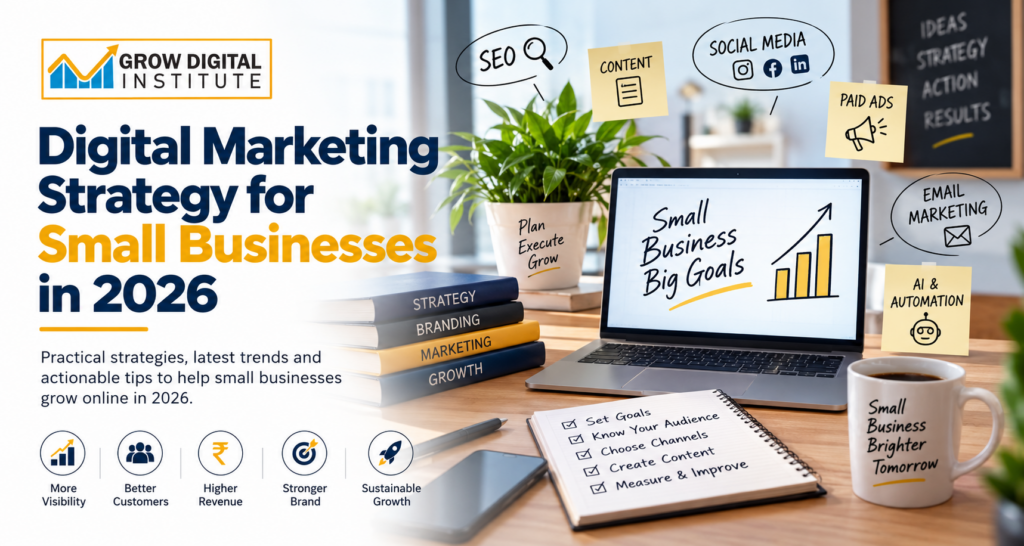
Digital Marketing Strategy for Small Businesses in 2026
For small businesses, having a strong online presence is no longer optional. Customers are searching on Google, checking social media profiles, comparing reviews, watching videos, using AI-powered search tools and looking for businesses near them before making a purchase decision.
But being present on multiple platforms is not the same as having a strategy.
A successful digital marketing strategy for small business should connect your website, SEO, Google Business Profile, social media, paid advertising, content marketing, WhatsApp and analytics into one clear plan.
In 2026, small businesses also need to think beyond traditional search. Customers increasingly discover brands through local search, social platforms and generative AI experiences. This makes useful, trustworthy and well-structured content more important than simply publishing large volumes of articles.
This guide explains how small businesses can build a practical digital marketing strategy in 2026, even with a limited marketing budget.
What Is a Digital Marketing Strategy for Small Business?

A digital marketing strategy is a planned approach to using online channels to attract the right audience, generate leads, convert customers and build long-term brand visibility.
A digital marketing strategy for small business typically combines:
- Search Engine Optimization (SEO)
- Google Business Profile and Local SEO
- Social media marketing
- Google Ads and paid advertising
- Content marketing
- Email and WhatsApp marketing
- Website optimization
- Online reputation management
- Analytics and conversion tracking
- AI-assisted marketing
The important point is that these channels should not operate separately.
For example, a local business may use SEO to attract someone searching for a service, Google Ads to capture high-intent customers immediately, Instagram to build trust, and WhatsApp to convert enquiries into appointments.
That is a strategy. Simply posting on Instagram every day is not.
Why Small Businesses Need Digital Marketing in 2026

Small businesses face strong competition from established brands as well as other local businesses. Digital marketing can help smaller companies compete by targeting specific audiences, locations and customer needs.
A well-planned strategy can help you:
- Increase online visibility
- Reach customers in specific locations
- Generate qualified leads
- Build brand awareness
- Reduce dependence on referrals
- Increase website traffic
- Improve local search visibility
- Retarget potential customers
- Measure marketing performance
- Build long-term organic traffic
The advantage of digital marketing is that businesses can measure much of the customer journey—from impressions and website visits to enquiries, calls, purchases and repeat customers.
Step 1: Define Your Target Audience
Before selecting marketing channels, understand exactly who you want to reach.
Create a simple customer profile covering:
- Age group
- Location
- Profession or business type
- Interests
- Problems and needs
- Buying behaviour
- Approximate budget
- Search behaviour
- Preferred communication channel
For example, a digital marketing institute in Mumbai may target college students, working professionals, business owners and people looking for career-oriented digital marketing courses.
Each audience may have different questions and conversion triggers.
Instead of saying, “We want more customers,” define a measurable audience such as:
Working professionals in Mumbai looking to learn digital marketing for a career change.
This makes your SEO, advertising and content strategy much more focused.
Step 2: Set Clear Marketing Goals
Your digital marketing strategy should have measurable objectives.
Common goals include:
- Generate 100 qualified leads per month
- Increase organic website traffic by 30%
- Generate 20 enquiries from Google Business Profile
- Increase online sales by 15%
- Reduce cost per lead
- Increase conversion rate
- Improve rankings for important commercial keywords
Use specific targets instead of vague goals such as “increase followers.”
For example:
Goal: Generate 50 qualified leads per month from Google and Meta Ads.
KPI: Cost per lead, lead quality and conversion rate.
This makes it easier to determine whether your marketing investment is producing business results.
Step 3: Build a Strong Website
Your website is the foundation of your online presence.
Before spending heavily on advertising, make sure your website provides a good experience on mobile and desktop.
Important elements include:
- Clear homepage messaging
- Service or product pages
- Strong calls to action
- Contact information
- WhatsApp or enquiry options
- Fast-loading pages
- Mobile-friendly design
- Trust signals and testimonials
- FAQs
- Clear location information
- Original and useful content
Your website should answer three questions quickly:
What do you offer?
Who is it for?
Why should customers choose you?
A website should not simply look attractive. It should help visitors take the next step.
Step 4: Make SEO a Long-Term Priority
SEO helps your business attract people who are already searching for your products, services or information.
A strong small-business SEO strategy should cover:
Keyword Research
Identify keywords based on search intent.
For example:
- Informational: “how does SEO work?”
- Commercial: “best digital marketing agency”
- Transactional: “digital marketing course fees”
- Local: “digital marketing institute in Borivali”
Do not create separate pages for every minor keyword variation. Build comprehensive pages around meaningful topics and search intent.
On-Page SEO
Optimize:
- Page titles
- H1 and H2 headings
- URLs
- Meta descriptions
- Image alt text
- Internal links
- Relevant content
- Structured information where appropriate
Google recommends using words people actually search for in prominent locations while keeping the content useful and natural.
Content SEO
Create content that genuinely answers customer questions.
Instead of publishing dozens of short articles, build authoritative resources around your main services.
For example, a digital marketing agency could create a topic cluster around:
Digital Marketing
→ SEO
→ Local SEO
→ Google Ads
→ Social Media Marketing
→ Content Marketing
→ Email Marketing
→ Lead Generation
→ Marketing Analytics
This helps establish topical depth.
Step 5: Focus on Local SEO
For businesses serving a particular city or area, Local SEO can be one of the most valuable parts of a digital marketing strategy for small business.
Start by optimizing your Google Business Profile.
Make sure your:
- Business name
- Address
- Phone number
- Website
- Business category
- Services
- Business hours
- Photos
- Reviews
are accurate and complete.
Google explains that local results are primarily influenced by relevance, distance and prominence. Complete and accurate business information helps Google understand which searches the business is relevant to.
Your website should also support local visibility through useful location and service pages rather than simply repeating city names.
For example:
Digital Marketing Course in Borivali
is more useful as a dedicated, genuinely helpful page than inserting “Borivali” repeatedly into unrelated content.
Step 6: Use Social Media to Build Trust
Social media should not only be used to promote products.
Use it to demonstrate expertise and answer customer questions.
A simple content mix could include:
- Educational posts
- Customer testimonials
- Behind-the-scenes content
- Product demonstrations
- FAQs
- Short videos
- Case studies
- Industry insights
- Offers
- Founder or team content
For example, a local service business could create a weekly Reel answering a common customer question.
This creates familiarity before someone contacts the business.
The goal is not to be active on every social network. Choose the platforms where your target customers actually spend time.
Step 7: Use Google Ads for Immediate Visibility
SEO can take time. Paid advertising can help businesses reach high-intent customers faster.
Google Ads can be useful for searches where people are actively looking for a product or service.
For example:
“digital marketing course in Mumbai”
shows stronger commercial intent than a broad search such as:
“what is digital marketing?”
A small business should begin with a controlled budget, relevant keywords, strong landing pages and proper conversion tracking.
Do not measure Google Ads only by clicks.
Track:
- Leads
- Calls
- Sales
- Cost per lead
- Conversion rate
- Customer acquisition cost
- Revenue generated
The objective is business growth—not simply traffic.
Step 8: Create Content That Answers Real Questions
Content marketing can support every stage of the customer journey.
Create content around questions your customers actually ask.
For example:
Awareness:
What is digital marketing?
Consideration:
How much does digital marketing cost for a small business?
Decision:
How do I choose a digital marketing agency?
Local:
Which digital marketing agency is best in Mumbai?
Post-purchase:
How can I get better results from my marketing campaign?
This approach also supports Answer Engine Optimization (AEO), because clearly structured answers make content easier for search systems and AI experiences to understand.
Google’s current guidance for AI search emphasizes original, useful, people-first content and encourages businesses to bring unique expertise or perspectives rather than simply rewriting information already available online.
Step 9: Use AI as a Marketing Assistant
AI can make marketing workflows faster, but it should not replace strategy or expertise.
Small businesses can use AI to assist with:
- Content ideas
- Keyword research
- Customer persona development
- Ad copy variations
- Social media planning
- Email drafts
- Data analysis
- Content briefs
- FAQ generation
- Competitor research
- Marketing reports
However, simply publishing large quantities of AI-generated content is not a strategy.
Review, improve and add your own experience to AI-assisted content.
Google’s guidance emphasizes that content should provide value to people rather than being created primarily to manipulate search rankings.
Step 10: Build a Conversion-Focused Marketing Funnel
Getting visitors is only the first step.
A simple funnel could look like:
Search / Social Media / Ads
↓
Website or Landing Page
↓
Enquiry / WhatsApp / Call / Form
↓
Sales Follow-Up
↓
Customer
↓
Review / Referral / Repeat Purchase
Every stage should have a clear purpose.
For example, if an advertising campaign generates 500 website visitors but only two enquiries, increasing the advertising budget may not solve the problem.
The landing page, offer, targeting or conversion process may need improvement.
Step 11: Track the Right KPIs
Your marketing dashboard should focus on business outcomes.
Important metrics include:
| Channel | Important KPIs |
| SEO | Organic traffic, rankings, conversions |
| Google Business Profile | Calls, website visits, directions, interactions |
| Google Ads | Leads, conversions, CPL, ROAS |
| Social Media | Reach, engagement, enquiries |
| Website | Traffic, conversion rate, bounce/engagement signals |
| Open rate, clicks, conversions | |
| Enquiries, response rate, conversions |
Avoid judging success only by followers, likes or impressions.
A campaign with 10,000 views and zero customers may be less valuable than one with 2,000 views and 20 qualified leads.
How Much Should a Small Business Spend on Digital Marketing?
There is no universal budget that works for every business.
Your budget depends on:
- Industry
- Location
- Competition
- Average customer value
- Sales cycle
- Marketing goals
- Available resources
- Existing organic visibility
A small business can begin with a focused strategy instead of trying to use every marketing channel simultaneously.
For example:
Phase 1: Website + Google Business Profile + basic SEO
Phase 2: Content + social media
Phase 3: Google Ads or Meta Ads
Phase 4: Retargeting + email/WhatsApp automation
Phase 5: Analytics + optimization
The objective should be to identify which channels generate profitable customers and gradually increase investment in those channels.
90-Day Digital Marketing Plan for Small Businesses
Month 1: Build the Foundation
- Audit your website
- Define your target audience
- Research keywords
- Optimize Google Business Profile
- Create important service pages
- Set up analytics and conversion tracking
- Establish social media content themes
Month 2: Start Generating Traffic
- Publish helpful SEO content
- Start regular social media content
- Build local citations and relevant mentions
- Launch targeted Google or Meta campaigns if appropriate
- Improve landing pages
- Collect genuine customer reviews
Month 3: Optimize and Scale
- Identify your highest-performing keywords
- Review advertising performance
- Improve conversion rates
- Update underperforming content
- Create more content around successful topics
- Retarget interested visitors where appropriate
- Increase investment in channels producing qualified customers
This approach turns digital marketing into an ongoing growth process rather than a one-time campaign.
Common Digital Marketing Mistakes Small Businesses Should Avoid
1. Trying Every Platform
You do not need to be everywhere. Focus on platforms that reach your customers.
2. Focusing Only on Followers
Followers do not automatically become customers. Track leads, sales and revenue.
3. Ignoring Local SEO
If you operate locally, your Google Business Profile and local visibility deserve consistent attention.
4. Publishing Content Without a Strategy
Every article should have a purpose, target audience and connection to your broader topic strategy.
5. Spending on Ads Without Tracking Conversions
Clicks are not the same as customers.
6. Keyword Stuffing
Repeating the same keyword unnaturally can make content difficult to read and does not create useful topical coverage. Focus on comprehensive answers and related concepts instead.
7. Ignoring Existing Customers
Marketing should not stop after the first sale. Reviews, referrals, repeat purchases and retention can be valuable growth channels.
Frequently Asked Questions
What is the best digital marketing strategy for a small business?
The best strategy depends on the business, audience, location and goals. For many small businesses, a combination of a strong website, SEO, Local SEO, Google Business Profile, social media and targeted paid advertising provides a strong foundation.
How can a small business start digital marketing with a low budget?
Start with the basics: optimize your website, create or improve your Google Business Profile, publish useful content, build social media consistency and set up conversion tracking. Add paid advertising after establishing a clear offer and conversion path.
Is SEO better than Google Ads for small businesses?
Neither is universally better. SEO can build long-term organic visibility, while Google Ads can provide faster visibility for high-intent searches. Many businesses benefit from using both strategically.
How important is Google Business Profile for local businesses?
It can be highly valuable for businesses that serve customers in specific locations. Google says local rankings are mainly based on relevance, distance and prominence, so maintaining complete and accurate business information is an important part of local visibility.
Can AI help small businesses with digital marketing?
Yes. AI can assist with research, content planning, copy variations, analysis and workflow automation. However, businesses should review AI-assisted content and add genuine expertise, experience and original information.
How long does a digital marketing strategy take to work?
Different channels work at different speeds. Paid advertising can generate results relatively quickly when campaigns and tracking are set up correctly, while SEO and content marketing generally require consistent effort over a longer period. Search visibility can change over time, and Google notes that improvements may take days to months to be reflected fully.
Final Thoughts
A successful digital marketing strategy for small business is not about using the maximum number of platforms. It is about choosing the right channels, understanding your customers and consistently improving the path from discovery to conversion.
In 2026, small businesses should think beyond simply ranking on Google or gaining social media followers. Build a strong website, create useful content, optimize your local presence, use paid advertising intelligently, embrace AI where it adds value and measure the results that actually contribute to business growth.
Most importantly, focus on being useful.
When your website answers customer questions, your Google Business Profile provides accurate information, your social media builds trust and your advertising reaches people with genuine intent, your digital channels begin working together.
That is what turns digital marketing from an expense into a sustainable growth system.Want to learn how to build and implement digital marketing strategies for real businesses? Explore the practical Advanced Digital Marketing Courses in Borivali at Grow Digital Institute, where students can learn SEO, Google Ads, Meta Ads, social media marketing, content marketing, WordPress, analytics and AI-powered digital marketing.