
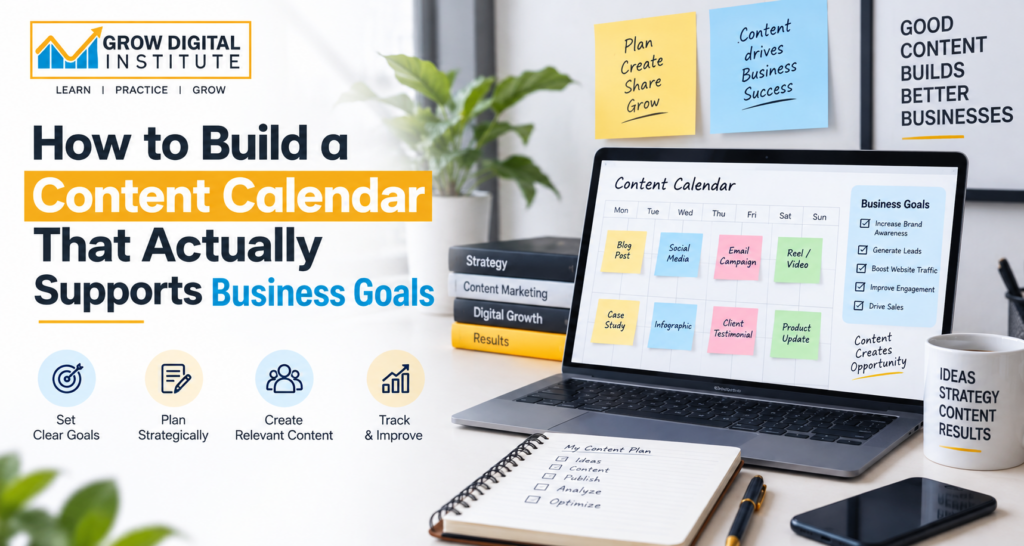
How to Build a Content Calendar That Actually Supports Business Goals
Creating content consistently is not the same as having a content strategy.
Many businesses publish Instagram posts, blogs, videos, LinkedIn updates and other content every week but still struggle to generate leads, sales or meaningful engagement. The problem is often not the lack of content. It is the lack of direction behind that content.
A well-planned content calendar for business goals helps businesses decide what to publish, why to publish it, who it is for and what result it should support.
Instead of creating content simply because “we need to post today,” businesses can build a system where every piece of content has a clear purpose.
In this guide, we will explain how to create a content calendar that connects content marketing with real business objectives.
What Is a Content Calendar?
A content calendar is a planned schedule that organizes the content a business intends to publish across different platforms and formats.
It can include:
- Blog articles
- Instagram posts
- Reels
- LinkedIn posts
- YouTube videos
- Email newsletters
- Case studies
- Customer testimonials
- Lead magnets
- Website content
- Promotional campaigns
- Seasonal content
A good content calendar usually contains information such as:
| Element | Purpose |
| Content topic | What will be published |
| Content format | Blog, Reel, carousel, video, etc. |
| Platform | Where it will be published |
| Target audience | Who the content is for |
| Business goal | What the content should support |
| CTA | What the audience should do next |
| Keyword | SEO opportunity, if applicable |
| Publishing date | When it will go live |
| Status | Planned, in progress or published |
| Performance | Results after publishing |
The important point is that a content calendar should not simply be a list of dates and post ideas. It should connect content activities with business objectives.
Why Should a Content Calendar Be Connected to Business Goals?
Content can support several different business objectives.
For example, a business may want to:
- Increase brand awareness
- Generate leads
- Increase website traffic
- Improve search visibility
- Build authority
- Educate potential customers
- Promote a product or service
- Improve customer retention
- Generate enquiries
- Increase sales
Each goal requires a different type of content.
For example, if the primary goal is lead generation, publishing only motivational posts may create engagement but may not necessarily generate qualified enquiries.
Instead, the content calendar could include:
- Problem-solving blog posts
- Service comparison content
- Case studies
- Customer testimonials
- FAQs
- Product demonstrations
- Lead-generation landing pages
- Strong but relevant calls to action
This is why businesses should define the goal before deciding what content to publish.
Step 1: Define Your Business Goals First
The first step in creating a content calendar for business goals is to understand what the business actually wants to achieve.
Ask:
What should our content help the business accomplish?
For example:
Goal: Generate More Leads
Content can focus on:
- Customer pain points
- Service benefits
- FAQs
- Case studies
- Testimonials
- Product demonstrations
- “How to choose” guides
Goal: Increase Brand Awareness
Content can focus on:
- Educational posts
- Industry insights
- Founder stories
- Behind-the-scenes content
- Original research
- Expert opinions
- Short-form videos
Goal: Increase Organic Traffic
Content can focus on:
- Search-intent-based blog articles
- Topic clusters
- Comparison pages
- FAQs
- Long-tail keywords
- Location-based searches
Goal: Improve Customer Retention
Content can include:
- Product education
- Tutorials
- Maintenance tips
- Customer-exclusive information
- Frequently asked questions
- New feature announcements
The goal determines the content direction.
Step 2: Identify Your Target Audience
A content calendar becomes much more effective when you know exactly who you are creating content for.
Instead of defining your audience simply as “everyone,” create specific audience groups.
For example, a digital marketing courses in borivali may have:
- College students
- Working professionals
- Business owners
- Freelancers
- Entrepreneurs
- Marketing professionals
Each audience may have different questions and motivations.
A student may search:
“How to start a career in digital marketing?”
A business owner may search:
“How can digital marketing generate leads for my business?”
A freelancer may search:
“Which digital marketing skills should freelancers learn?”
These different search intents can become separate content opportunities.
Step 3: Map Content to the Customer Journey
Not every person who sees your content is ready to buy.
Some people are discovering the problem. Others are researching solutions. Some are already comparing providers.
Your content calendar should address different stages of the customer journey.
Awareness Stage
The audience is identifying a problem or learning something new.
Content examples:
- What is digital marketing?
- Why does SEO matter?
- How does Google Ads work?
- Digital marketing trends
Consideration Stage
The audience is actively researching solutions.
Content examples:
- SEO vs Google Ads
- How to choose a digital marketing course
- Benefits of practical digital marketing training
- Skills required for a digital marketing career
Decision Stage
The audience is closer to taking action.
Content examples:
- Course curriculum
- Student testimonials
- Case studies
- Training methodology
- Course FAQs
- Placement assistance information
Retention and Advocacy
Existing customers or students can also become part of the content strategy.
Content examples:
- Student success stories
- Alumni experiences
- Advanced learning resources
- Community updates
- Achievements and certifications
This prevents the calendar from becoming heavily promotional.
Step 4: Build Content Pillars
Content pillars are the main subjects around which your content strategy is organized.
A business could have four to six primary content pillars.
For a digital marketing institute, these might include:
1. Digital Marketing Education
Examples:
- What is digital marketing?
- SEO basics
- Google Ads fundamentals
- Social media marketing
2. Career and Skills
Examples:
- Digital marketing career opportunities
- Skills companies look for
- Freelancing opportunities
- Career paths in digital marketing
3. Practical Marketing
Examples:
- SEO strategies
- Google Ads tips
- Meta Ads strategies
- Conversion optimization
4. Industry Trends
Examples:
- AI in digital marketing
- Search trends
- Marketing automation
- Changes in social media
5. Student and Institute Content
Examples:
- Student projects
- Testimonials
- Workshops
- Certifications
- Classroom activities
6. Course and Conversion Content
Examples:
- Course modules
- Training methodology
- FAQs
- Admission information
- Demo or introductory sessions
These pillars make it easier to maintain consistency while avoiding repetitive topics.
Step 5: Research What Your Audience Is Searching For
Search behaviour should influence your content calendar.
Use tools such as:
- Google Search
- Google Trends
- Google Search Console
- Google Keyword Planner
- Semrush
- Ahrefs
- AnswerThePublic
- AlsoAsked
Look for questions, problems and comparisons related to your products or services.
For SEO, don’t focus only on high-volume keywords.
Long-tail searches can reveal highly specific user intent.
For example:
Instead of targeting only:
“digital marketing”
you could explore:
- digital marketing course in Mumbai
- digital marketing course for working professionals
- how to learn digital marketing
- digital marketing skills for beginners
- SEO course in Mumbai
- how to start a digital marketing career
These searches can generate more focused content ideas.
Step 6: Include AEO-Friendly Questions
Modern search behaviour is increasingly conversational.
People don’t always search using short keywords. They also ask complete questions.
This makes Answer Engine Optimization (AEO) an important part of content planning.
Your content calendar should include question-based topics such as:
- What is a content calendar?
- How often should a business publish content?
- What should a content calendar include?
- How do you create a content strategy?
- What are the benefits of content marketing?
- How do you measure content marketing success?
For important questions, provide a direct answer near the beginning of the relevant section.
For example:
What Is the Purpose of a Content Calendar?
A content calendar helps businesses plan, organize and manage content consistently while connecting individual content pieces with marketing and business objectives.
Then expand on the answer with supporting information.
This structure can make content easier for both users and search systems to understand.
Step 7: Make the Content GEO-Friendly
Generative Engine Optimization, or GEO, focuses on making information clear, useful and easy for AI-powered search and answer systems to interpret.
A GEO-friendly article should:
- Answer questions directly
- Use clear headings
- Provide specific information
- Explain concepts in simple language
- Include relevant examples
- Use structured lists and tables
- Demonstrate expertise
- Avoid unnecessary filler
- Support claims with credible sources when appropriate
For businesses, this means your content should be written to genuinely answer the questions your target audience is asking.
Don’t create content simply to insert keywords.
Create content that provides useful information.
Step 8: Assign Every Content Piece a Purpose
One of the biggest mistakes businesses make is publishing content without knowing what it is supposed to achieve.
Before adding an item to your calendar, ask:
What is the purpose of this content?
For example:
| Content | Purpose |
| Educational Reel | Awareness |
| SEO Blog | Organic traffic |
| Case Study | Trust |
| Testimonial | Social proof |
| Product Demo | Consideration |
| Offer Post | Conversion |
| FAQ Article | Search visibility |
| Founder Story | Brand building |
This simple exercise can make your content calendar much more strategic.
Step 9: Add a Clear CTA
Every piece of content does not need to sell something.
However, important conversion-focused content should have a logical next step.
Examples include:
- Read the full guide
- Download the checklist
- Book a consultation
- Enquire now
- Register for a workshop
- Visit the website
- Explore the course
- Contact our team
- Request a quote
The CTA should match the intent of the content.
For example, an educational article about SEO basics may naturally direct readers to another SEO guide rather than immediately asking them to purchase a service.
Step 10: Create a Balanced Monthly Content Mix
A practical content calendar should contain different content types.
For example, a monthly plan could include:
40% Educational Content
Build knowledge and organic visibility.
20% Trust-Building Content
Use testimonials, case studies, results and expertise.
20% Engagement Content
Use questions, polls, discussions and interactive formats.
20% Promotional Content
Highlight products, services, offers or upcoming events.
These percentages are not a fixed rule. The right mix depends on the business, audience and marketing objectives.
The important thing is to avoid making every post promotional.
Step 11: Build Your Calendar Around Campaigns
Instead of planning every post independently, organize related content around campaigns.
For example, if a digital marketing institute is promoting a new course batch, the content could be structured like this:
Week 1: Awareness
- Digital marketing career trends
- Skills required in digital marketing
- Career opportunities
Week 2: Education
- SEO explained
- Google Ads explained
- Meta Ads explained
- Real-world marketing examples
Week 3: Trust
- Student testimonials
- Student projects
- Trainer introduction
- Classroom experience
Week 4: Conversion
- Course curriculum
- FAQs
- Batch information
- Registration CTA
This creates a journey instead of a collection of unrelated posts.
Step 12: Repurpose Your Best Content
Creating completely new content every day is inefficient.
Instead, turn one strong piece of content into multiple formats.
For example:
One blog:
“Digital Marketing Strategy for Small Businesses”
can become:
- 1 LinkedIn post
- 1 Instagram carousel
- 2–3 Reels
- 5 Instagram Story ideas
- 1 email newsletter
- 1 infographic
- 5 FAQ questions
- 1 short video
- Several internal-link opportunities
This approach allows businesses to get more value from content they have already researched and created.
Step 13: Measure Business Results
A content calendar should not end with the word “Published.”
Add performance tracking to your calendar.
Depending on your objective, track:
Awareness
- Reach
- Impressions
- Video views
- Brand searches
Engagement
- Likes
- Comments
- Shares
- Saves
- Engagement rate
SEO
- Organic clicks
- Impressions
- Rankings
- Organic traffic
- Indexed pages
Lead Generation
- Form submissions
- Calls
- WhatsApp enquiries
- Consultation requests
- Qualified leads
Sales
- Purchases
- Revenue
- Conversion rate
- Cost per acquisition
This helps you understand which content contributes to actual business outcomes.
What Should a Business Content Calendar Include?
A useful content calendar can include the following columns:
| Date | Topic | Format | Platform | Audience | Goal | Keyword | CTA | Status | Result |
| 5 Oct | SEO Basics | Carousel | Beginners | Awareness | SEO basics | Read blog | Planned | — | |
| 8 Oct | SEO Guide | Blog | Website | Business owners | Traffic | SEO for small business | Contact | Planned | — |
| 12 Oct | Student Story | Reel | Students | Trust | — | Enquire | Planned | — | |
| 15 Oct | Course FAQ | Blog | Website | Prospects | Conversion | digital marketing course | Enquire | Planned | — |
You can manage this using Google Sheets, Excel, Notion, Trello or other project-management tools.
The platform is less important than the strategy behind the calendar.
Common Content Calendar Mistakes to Avoid
1. Posting Without a Goal
Every post does not need a sales objective, but your overall content strategy should support business objectives.
2. Focusing Only on Trending Topics
A trending topic may generate attention but may have little connection with your target customer.
3. Publishing Only Promotional Content
Constant selling can reduce audience interest and trust.
4. Ignoring Search Intent
If SEO is part of your strategy, content should reflect what people are actually searching for.
5. Creating Content for Every Platform
You don’t necessarily need to be active everywhere.
Focus on platforms where your target audience is actually present.
6. Not Reviewing Performance
If you never analyze results, your content calendar becomes a publishing schedule rather than a marketing system.
7. Creating Too Much Content
More content does not automatically mean better results.
A smaller amount of useful, relevant and well-distributed content can be more valuable than publishing simply to fill a calendar.
A Simple Content Calendar Framework
You can use this five-step framework:
Business Goal → Audience → Content Pillar → Content Format → CTA
For example:
Goal: Generate course enquiries
↓
Audience: Working professionals
↓
Content Pillar: Digital marketing career
↓
Format: Blog + Reel + Carousel
↓
CTA: Explore the course
This keeps the content connected to the business objective.
How Often Should a Business Update Its Content Calendar?
There is no universal publishing frequency that works for every business.
A practical approach is to:
- Plan the calendar monthly
- Review performance weekly
- Adjust upcoming content based on results
- Conduct a deeper strategy review every quarter
If a topic performs well, consider expanding it into related content.
If a content category consistently receives little engagement or fails to support business objectives, reassess its role in the strategy.
The goal is not to create a perfect calendar months in advance. The goal is to create a flexible system that improves based on data.
Frequently Asked Questions
What is a content calendar in digital marketing?
A content calendar is a structured plan that organizes what content a business will publish, where it will be published, when it will be published and what objective it is intended to support.
How does a content calendar help a business?
A content calendar helps businesses maintain consistency, organize campaigns, target different audience stages and connect content with objectives such as traffic, leads, engagement and sales.
What should a content calendar include?
A content calendar can include the publishing date, topic, content format, platform, target audience, business goal, keyword, CTA, status and performance metrics.
How far in advance should content be planned?
Many businesses plan content approximately one month in advance while leaving room for current events, trends and performance-based changes.
Should every piece of content have a CTA?
Not necessarily. Educational and awareness content can focus on providing value, while consideration and conversion content can use a more direct CTA.
How do you measure whether a content calendar is working?
Measure the metrics connected to the original business goal. These can include organic traffic, rankings, engagement, leads, enquiries, conversions or revenue.
Final Thoughts
A content calendar should be more than a list of social media posts and publishing dates.
A strategic content calendar for business goals connects business objectives with audience needs, search intent, content formats and measurable outcomes.
The process is simple:
Set the goal → Understand the audience → Choose content pillars → Research topics → Map the customer journey → Create the calendar → Publish → Measure → Improve.
When every content decision has a reason behind it, content marketing becomes easier to manage and much more closely connected to business growth.
For businesses and aspiring digital marketers, learning how to build this connection between content strategy, SEO, AEO, GEO and business objectives is an important practical marketing skill.
At Grow Digital Institute, practical digital marketing training can help learners understand how modern marketing strategies are planned, implemented and measured across different digital channels.