
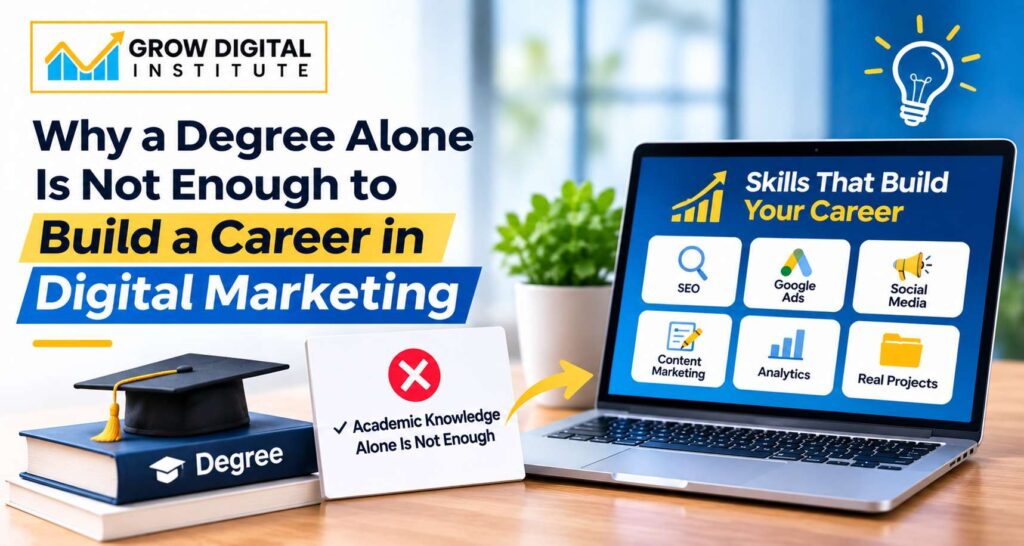
Why a Degree Alone Is Not Enough to Build a Digital Marketing career for freshers
Completing a graduation degree is an important milestone. It gives students academic knowledge, develops their understanding of different subjects and helps them qualify for various job opportunities. However, when it comes to building a successful career in digital marketing, having a degree alone may not be enough.
Today, companies are looking for professionals who can do more than explain marketing concepts. They need people who understand how to manage social media accounts, improve website rankings, run advertising campaigns, generate leads, analyse marketing data and use digital tools effectively.
This is where the difference between academic education and practical learning becomes important.
The digital marketing industry is constantly evolving. New advertising features, search engine updates, social media platforms and AI-powered tools are changing how businesses connect with customers. Students entering this industry need to understand how these tools and strategies work in real business situations.
So, is a degree enough to build a digital marketing career? Not necessarily. A degree can provide a strong educational foundation, but practical skills, industry exposure and continuous learning help students become more prepared for professional opportunities.
Let’s understand why.
1. A Degree Provides Knowledge, But Companies Need Practical Skills
Most traditional degree programmes focus on academic concepts, theoretical understanding and examinations. These are valuable for developing a strong educational foundation.
However, digital marketing is an implementation-driven profession.
For example, understanding the definition of Search Engine Optimisation (SEO) is different from knowing how to perform keyword research, optimise website pages, analyse competitors and improve organic search visibility.
Similarly, learning about advertising in a classroom is different from creating a Google Ads campaign, selecting relevant keywords, setting budgets and monitoring conversions.
Employers generally want candidates who can apply their knowledge to actual business requirements.
Some practical tasks a digital marketing professional should understand include:
- Conducting keyword research using SEO tools.
- Creating and managing Google Ads campaigns.
- Planning social media marketing strategies.
- Designing marketing creatives and content calendars.
- Optimising website pages for search engines.
- Creating landing pages using WordPress.
- Analysing website traffic through Google Analytics 4.
- Tracking campaign performance and preparing reports.
- Understanding lead generation and conversion optimisation.
These skills require practice, not just theoretical knowledge.
The important takeaway: Your degree tells an employer what you have studied. Your practical skills demonstrate what you can actually do.
2. The Digital Marketing Industry Changes Faster Than Traditional Learning
One of the biggest challenges in digital marketing is keeping up with industry changes.
Search engines regularly update their algorithms. Social media platforms introduce new advertising features. Businesses adopt automation to improve their marketing activities, and artificial intelligence is changing how marketers research, create and analyse content.
Students who depend only on previously learned academic concepts may find it difficult to adapt to these developments.
Consider some important areas that modern digital marketers need to understand:
| Digital marketing area | Practical knowledge required |
| SEO | Keyword research, technical SEO, on-page and off-page optimisation |
| Google Ads | Campaign creation, bidding, targeting and conversion tracking |
| Meta Ads | Audience targeting, creative testing and lead generation |
| Social Media | Content planning, engagement and performance analysis |
| Analytics | GA4, Search Console and campaign reporting |
| AI Marketing | Research, automation, content assistance and productivity |
| Website Management | WordPress, landing pages and website optimisation |
A good digital marketer must be willing to learn continuously.
This is why practical digital marketing training should include updated tools, current industry practices and opportunities to implement different marketing strategies.
3. Employers Look Beyond Your Educational Qualification
Imagine two candidates applying for the same digital marketing executive position.
Candidate A:
- Holds a graduation degree.
- Understands digital marketing terminology.
- Has completed theoretical assignments.
- Has limited experience using marketing platforms.
Candidate B:
- Holds a graduation degree.
- Understands SEO, Google Ads and social media marketing.
- Has completed practical assignments.
- Can demonstrate website optimisation and campaign projects.
- Understands how to analyse marketing performance.
Both candidates have academic qualifications, but Candidate B can demonstrate a stronger practical understanding of the role.
This does not mean that every employer will automatically choose the second candidate. Hiring decisions also depend on communication, attitude, aptitude and the company’s requirements.
However, practical experience gives candidates something valuable to discuss during interviews.
Instead of simply saying, “I know SEO,” you can explain how you performed keyword research, identified website optimisation opportunities or worked on a sample SEO strategy.
That makes your knowledge easier for recruiters to evaluate.
4. Practical Experience Helps Freshers Overcome the Experience Gap
One common problem fresh graduates face is the experience gap.
Many entry-level job descriptions ask for candidates who understand digital marketing tools and workflows. However, freshers may have little or no professional exposure to these activities.
This creates a difficult situation. Students need experience to become more employable, but they need opportunities to gain that experience.
The solution is to start building practical experience before applying for full-time positions.
Students can gain experience through:
Live Projects
Working on actual business requirements helps students understand how marketing strategies are planned and implemented.
For example, a student can work on keyword research, website optimisation, social media planning or a lead-generation campaign.
Internships
Internships introduce students to professional working environments, deadlines, client requirements and reporting processes.
They also help students understand how different marketing activities are managed within an organisation.
Personal Projects
Students can create their own websites, develop a blog, manage a social media page or build a sample advertising strategy.
These projects can demonstrate initiative and practical understanding.
Case Studies
Studying existing business campaigns helps students understand marketing decisions, audience targeting, creative strategies and performance measurement.
For additional guidance, read our blog on How to Create a Digital Marketing Portfolio Without Work Experience. It explains how beginners can demonstrate their skills even before getting their first job.
5. Knowing Digital Marketing Tools Is Different From Using Them
Digital marketing involves multiple platforms and tools.
Simply knowing the names of popular tools does not mean that someone can use them professionally.
For example:
- Knowing Google Analytics is different from analysing website traffic and user behaviour.
- Knowing Google Ads is different from building and optimising advertising campaigns.
- Knowing Canva is different from designing creatives that follow a brand’s marketing objectives.
- Knowing WordPress is different from creating and optimising a business website.
- Knowing SEO tools is different from using their data to improve website visibility.
Employers value candidates who understand how to use tools to solve marketing problems.
Students should therefore focus on learning the purpose of each platform, understanding its features and practising its application.
At Grow Digital Institute, practical learning focuses on helping students understand how different digital marketing platforms are used in real-world marketing activities.
6. Communication and Problem-Solving Skills Matter Too
Digital marketing is not limited to technical knowledge.
Professionals frequently communicate with clients, business owners, designers, content writers, sales teams and other marketing professionals.
They need to understand business objectives and explain how marketing activities contribute to those objectives.
For example, a client may ask why website traffic has increased but enquiries have not improved.
A digital marketer should be able to investigate possible reasons, such as:
- Irrelevant website visitors.
- Poor landing page experience.
- Weak calls to action.
- Incorrect audience targeting.
- Technical website issues.
- Poor conversion tracking.
This requires analytical thinking and problem-solving skills.
Other important soft skills include:
- Written and verbal communication.
- Time management.
- Creativity.
- Adaptability.
- Teamwork.
- Client communication.
- Presentation skills.
A candidate who combines technical knowledge with strong communication skills can be better prepared for professional responsibilities.
7. Building a Portfolio Can Make Your Resume Stronger
A resume containing only educational qualifications and certificates may not fully communicate your practical abilities.
This is why building a digital marketing portfolio is useful, particularly for freshers.
A portfolio allows you to present your work and demonstrate what you have learned.
Here are some projects beginners can include:
| Project | What it demonstrates |
| SEO Audit | Website analysis and optimisation |
| Keyword Research | Search intent and keyword selection |
| Google Ads Campaign | Advertising knowledge and campaign planning |
| Social Media Calendar | Content strategy and planning |
| Website Project | WordPress and website management |
| Analytics Report | Data interpretation and reporting |
| Meta Ads Strategy | Audience research and lead generation |
Even sample projects can be useful when clearly identified as practice or demonstration projects.
If you have worked on real client campaigns, you can include relevant work with permission and avoid sharing confidential business information.
A well-organised portfolio gives recruiters a better understanding of your capabilities.
8. AI Is Changing Digital Marketing, Making Practical Knowledge More Important
Artificial intelligence has introduced new possibilities in digital marketing.
Marketers now use AI-powered tools to support content research, keyword analysis, campaign planning, creative development, automation and reporting.
However, using AI does not automatically make someone a skilled digital marketer.
You still need to understand marketing fundamentals to evaluate the output and make informed decisions.
For example, AI can help generate blog ideas, but a marketer must understand search intent, keyword relevance, content quality and the target audience before publishing.
Similarly, AI can assist with advertising copy, but campaign performance still depends on audience selection, budget allocation, creative testing and optimisation.
Students should learn how to combine AI tools with practical marketing knowledge rather than depending entirely on automated content generation.
This is an important reason to choose digital marketing training that introduces learners to both traditional marketing fundamentals and modern AI applications.
9. A Digital Marketing Career Is Not Restricted to One Educational Background
Another misconception is that only students with a marketing or management degree can enter digital marketing.
In reality, people from different educational backgrounds can explore this field.
For example:
- Commerce graduates: Can explore performance marketing, advertising and analytics.
- Arts graduates: Can explore content marketing, social media and communication.
- Science graduates: Can explore analytics, SEO and data-driven marketing.
- Management graduates: Can explore digital strategy, marketing management and campaign planning.
- Media graduates: Can explore content creation, video marketing and social media management.
Your educational background can help you develop certain strengths, but your willingness to learn and develop relevant skills also matters.
Students who are interested in technology, creativity, communication, research or business growth can explore different digital marketing specialisations.
10. How Can Students Prepare for a Digital Marketing Career?
If you are a student or fresher planning to enter the digital marketing industry, start by building a structured learning plan.
Here are seven steps to help you prepare.
Step 1: Understand Digital Marketing Fundamentals
Start with the basics of SEO, social media marketing, paid advertising, content marketing, email marketing and website management.
Understand how these channels work together to achieve business goals.
Step 2: Learn Industry-Relevant Tools
Get familiar with platforms such as Google Ads, Google Analytics 4, Google Search Console, Meta Ads Manager, WordPress and SEO research tools.
Step 3: Practise What You Learn
Do not limit your learning to watching videos or reading notes. Complete assignments and implement different marketing activities.
Step 4: Work on Projects
Build a website, conduct an SEO audit, create a social media strategy or prepare a sample advertising campaign.
Step 5: Apply for Internship Opportunities
Internships help you understand professional expectations and gain exposure to actual marketing workflows.
Step 6: Build Your Portfolio and Prepare for Interviews
Document your projects, improve your resume and practise explaining your work confidently.
Step 7: Keep Learning and Updating Your Skills
Digital marketing is an evolving field. Stay updated with new platforms, AI tools, search developments and advertising practices.
Following these steps can help you move from academic learning towards practical professional readiness.
11. Why Choosing the Right Digital Marketing Training Institute Matters
Self-learning is a good starting point, but beginners may struggle to understand what to learn first, which tools to use and how to apply their knowledge.
A structured training programme can provide a clear learning path, expert guidance and opportunities to practise.
However, students should not select an institute based only on advertisements, certificates or placement promises.
Before joining, evaluate the following:
- Practical curriculum: Does the course include actual implementation?
- Industry tools: Will you learn platforms used by digital marketing professionals?
- Live projects: Can you work on practical business requirements?
- Trainer experience: Do trainers understand real-world marketing activities?
- Internship opportunities: Does the programme provide opportunities for industry exposure?
- Portfolio development: Will you have projects to demonstrate your skills?
- Career support: Does the institute provide resume guidance and interview preparation?
The right training environment should help students understand not only what digital marketing is but also how it works in professional situations.
How Grow Digital Institute Helps Students Build Practical Digital Marketing Skills
Why a Degree Alone Is Not Enough to Build a Digital Marketing career for freshers
At Grow Digital Institute, the focus is on bridging the gap between academic learning and the practical skills required by the digital marketing industry.
The institute was established to help students, freshers, working professionals, freelancers and entrepreneurs understand how digital marketing works beyond textbooks.
The Advanced Digital Marketing Programme is designed around practical learning, industry tools, assignments and real-world applications.
What students learn at Grow Digital Institute:
- 45+ advanced digital marketing modules.
- Search Engine Optimisation (SEO).
- Google Ads and Meta Ads.
- Social Media Marketing.
- Content Marketing and Email Marketing.
- Website Development and WordPress.
- Performance Marketing and Analytics.
- AI tools and prompt engineering.
- Live projects and practical assignments.
- Internship opportunities and career guidance.
The programme runs for four months, with two hours of daily training. Students also receive guidance for industry certifications, resume building and interview preparation.
With classroom training centres in Borivali and Andheri, Mumbai, students can choose a convenient learning location.
Explore the available programmes:
- Digital Marketing Courses in Borivali
- Digital Marketing Courses in Andheri
- Digital Marketing Courses in Mumbai
- Digital Marketing Career in Borivali: Complete Guide
The goal is not simply to help students complete a course. It is to help them develop the knowledge, practical abilities and confidence required to explore professional opportunities.
Conclusion: Your Skills Can Take Your Career Further Than Your Degree Alone
A graduation degree is an important achievement, but it should not be the only thing you depend on when planning your professional future.
The digital marketing industry requires people who can understand marketing strategies, use industry tools, analyse performance and implement campaigns.
Students who combine academic qualifications with practical skills, project experience, internships and continuous learning can build a stronger foundation for their careers.
Remember, you do not need to wait until you get your first job to start gaining experience. You can begin by learning the fundamentals, practising with industry tools and creating projects that demonstrate your abilities.
If you are serious about building a career in digital marketing, start investing in skills that you can actually apply.
Your degree is your foundation. Your skills, experience and ability to learn are what help you move forward.
Ready to Build Your Career in Digital Marketing?
Don’t limit your learning to textbooks. Develop practical skills, work on projects and understand how the digital marketing industry operates.
Join Grow Digital Institute and take your first step towards developing industry-relevant digital marketing skills.
Start Learning. Start Practising. Start Growing.
Explore our practical digital marketing programme in Borivali and Andheri, Mumbai.
Explore Our Digital Marketing Course
C
Frequently Asked Questions (AEO Optimisation)
These questions are designed to target Google Featured Snippets, People Also Ask results and AI-generated answers.
Is a degree enough to get a job in digital marketing?
A degree can help you qualify for job opportunities, but it may not be sufficient on its own. Employers also look for practical digital marketing skills, knowledge of industry tools, communication abilities and the ability to execute marketing activities.
Can I build a career in digital marketing without a marketing degree?
Yes. Digital marketing is open to graduates from commerce, arts, science, management and other educational backgrounds. Learning relevant skills, completing practical projects and gaining industry experience can help candidates enter the field.
What skills are required to become a digital marketer?
Important digital marketing skills include SEO, Google Ads, Meta Ads, social media marketing, content marketing, website management, analytics, email marketing and AI tools. Communication, creativity and analytical thinking are equally valuable.
Why is practical training important in digital marketing?
Practical training helps students understand how digital marketing tools and platforms work in real situations. It allows them to practise campaign creation, website optimisation, keyword research, social media management and performance analysis.
Can freshers get digital marketing jobs without experience?
Yes. Freshers can apply for internships and entry-level digital marketing positions. Building a portfolio through sample projects, practical assignments and internships can help demonstrate their capabilities to potential employers.
Is a digital marketing course necessary after graduation?
A digital marketing course is not compulsory, but structured training can help beginners understand different marketing channels, learn industry tools and gain practical experience. It can also provide guidance for projects, internships and interview preparation.
What is the difference between a digital marketing degree and a digital marketing course?
A degree generally provides broader academic education over a longer period, while a specialised digital marketing course focuses on developing skills related to online marketing channels, platforms and practical applications. Both can complement each other.
How long does it take to learn digital marketing?
The learning duration depends on the course structure, learning pace and practical exposure. Beginners can develop foundational knowledge within a few months, but becoming proficient requires continuous practice and industry experience.