
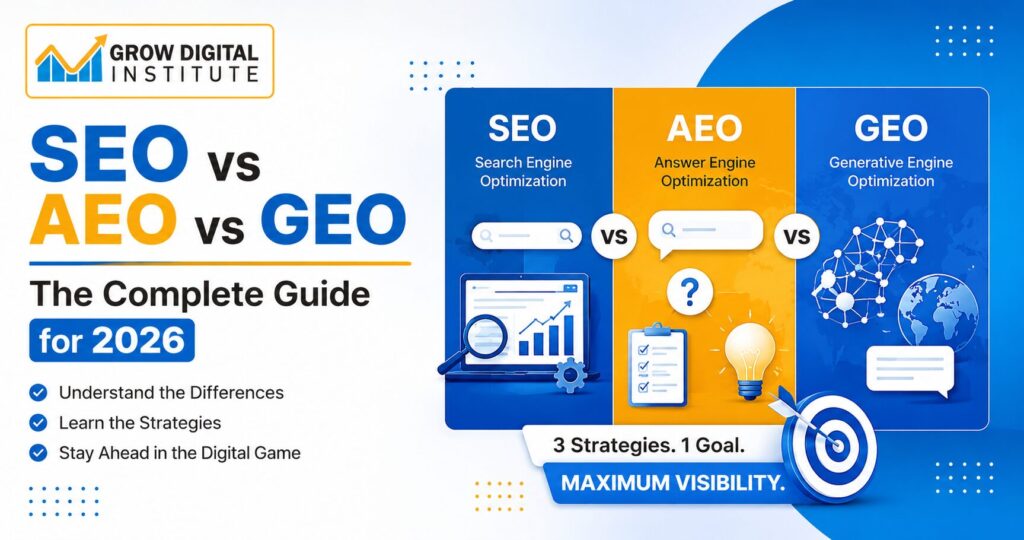
SEO vs AEO vs GEO: The Complete Guide for 2026
Search has changed dramatically over the last few years. Gone are the days when ranking on the first page of Google was the only goal for businesses. In 2026, users are searching for answers through multiple platforms, including Google Search, Google AI Overviews, ChatGPT, Gemini, Perplexity AI, Microsoft Copilot, and voice assistants.
This evolution has introduced three important concepts every marketer and small business owner should understand:
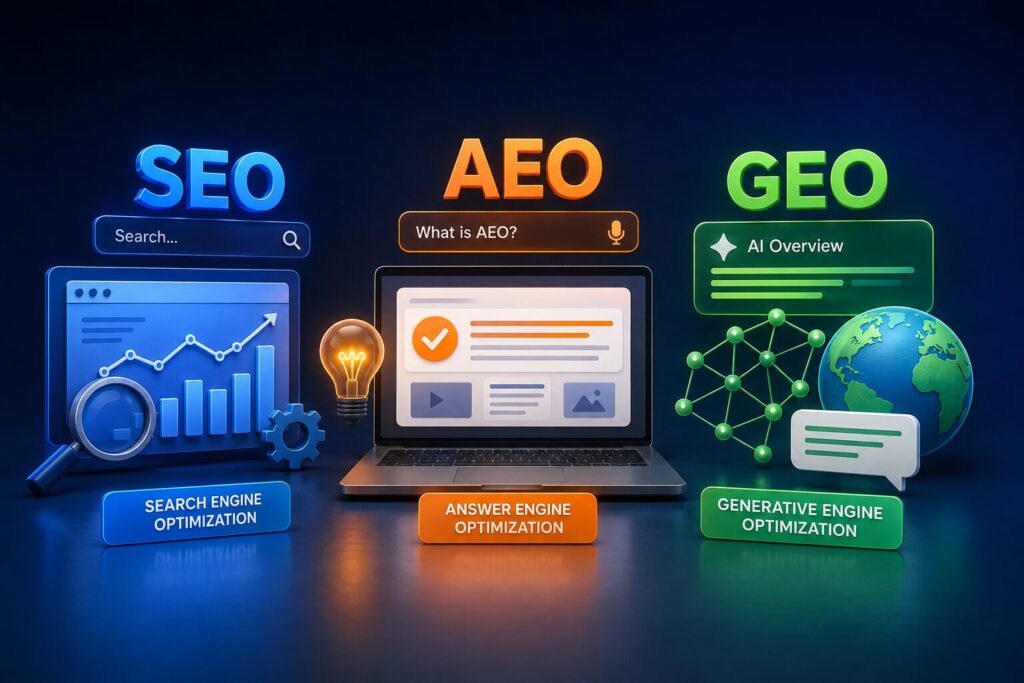
- SEO (Search Engine Optimization)
- AEO (Answer Engine Optimization)
- GEO (Generative Engine Optimization)
While these strategies share the common objective of increasing online visibility, each focuses on a different type of search experience. Businesses that optimize only for traditional search engines risk losing visibility in AI-powered search platforms that are rapidly becoming part of everyday online behaviour.
In this guide, you’ll learn the differences between SEO, AEO, and GEO, why they matter in 2026, and how you can combine all three strategies to future-proof your website.
What is SEO?
SEO (Search Engine Optimization) is the process of improving a website so that it ranks higher on search engines like Google and Bing for relevant keywords.
The primary goal of SEO is to attract organic traffic by making your website useful, relevant, and technically optimized.
For example, if someone searches:
“Best Digital Marketing Course in Borivali”
Google displays websites that it considers the most relevant and trustworthy. Websites that have strong SEO practices are more likely to appear on the first page.
Core Elements of SEO
1. Keyword Research
Keyword research helps identify what users are searching for. Choosing the right keywords allows businesses to create content that matches user intent.
Example keywords:
- Digital Marketing Course in Borivali
- SEO Course
- Google Ads Course
- AI in Digital Marketing
Long-tail keywords usually convert better because they match specific user needs.
2. High-Quality Content
Content remains the foundation of SEO.
Google rewards websites that publish:
- Helpful articles
- Original content
- Updated information
- Practical examples
- Clear explanations
Instead of writing for search engines, businesses should write for users while naturally incorporating target keywords.
3. On-Page SEO
On-page SEO includes optimizing:
- Page Titles
- Meta Descriptions
- Heading Tags (H1, H2, H3)
- Image ALT Text
- Internal Links
- URL Structure
- Keyword Placement
Proper on-page optimization helps search engines understand your content.
4. Technical SEO
Technical SEO ensures that search engines can crawl and index your website efficiently.
Important technical factors include:
- Mobile-friendly design
- Fast loading speed
- HTTPS security
- XML Sitemap
- Robots.txt
- Core Web Vitals
- Structured Data
A technically sound website offers a better user experience and improves ranking potential.
5. Backlinks
Backlinks are links from other websites pointing to your content.
High-quality backlinks signal trust and authority to search engines.
Quality matters far more than quantity. A few links from reputable websites are more valuable than hundreds of low-quality links.
What is AEO?
AEO (Answer Engine Optimization) focuses on optimizing content so that search engines and AI assistants can provide direct answers to user questions.
Unlike traditional SEO, AEO aims to help your content become the answer itself rather than just another search result.
Examples include:
- Google Featured Snippets
- Google AI Overviews
- Voice Search Results
- Google Assistant
- Siri
- Alexa
- Bing Copilot
When someone asks:
“What is SEO?”
Google often displays a short summarized answer above the regular search results.
That answer is generated from well-structured, authoritative content.
This is where AEO becomes important.
Why AEO Matters
Today’s users want immediate answers.
Instead of clicking through multiple websites, many people expect AI tools to summarize information instantly.
If your content provides:
- Clear definitions
- Simple explanations
- Bullet points
- FAQs
- Tables
- Step-by-step guides
it has a higher chance of appearing in answer engines.
Best Practices for AEO
Write Question-Based Headings
Examples:
- What is SEO?
- How does SEO work?
- Why is AEO important?
- What is the difference between SEO and GEO?
Question headings closely match how users search.
Answer Immediately
Provide the answer within the first 40–60 words before expanding with details.
This increases your chances of being selected for featured snippets and AI-generated summaries.
Use Lists and Tables
AI models prefer structured information.
Examples include:
- Numbered lists
- Bullet points
- Comparison tables
- Step-by-step guides
These formats improve readability for both users and AI systems.
Add FAQ Sections
Frequently Asked Questions help answer common user queries in a concise format.
They also improve the chances of appearing in rich search results.
What is GEO?
GEO (Generative Engine Optimization) is one of the newest digital marketing strategies designed for AI-powered search engines.
Instead of optimizing solely for Google’s traditional search results, GEO focuses on increasing visibility in AI-generated responses produced by platforms such as:
- ChatGPT
- Google Gemini
- Microsoft Copilot
- Perplexity AI
- Claude
These AI platforms don’t simply display a list of websites. They analyze multiple trusted sources, synthesize information, and generate conversational responses.
For your website to be included in those responses, your content must demonstrate authority, clarity, accuracy, and trustworthiness.
This shift makes GEO an essential strategy for businesses that want to remain visible as AI search continues to grow.
Why GEO is Becoming Important
AI-powered search engines are changing how users discover information.
Instead of typing:
“Best SEO tips for beginners”
Users now ask:
“Can you explain SEO in simple words?”
AI tools generate comprehensive answers by combining information from reliable websites.
If your content is well-structured, factually accurate, and demonstrates expertise, it has a greater chance of being referenced or reflected in AI-generated responses.
SEO vs AEO vs GEO: Key Differences
| Feature | SEO | AEO | GEO |
| Primary Goal | Rank higher in search results | Provide direct answers | Become a trusted AI source |
| Platforms | Google, Bing | Google AI Overview, Voice Search | ChatGPT, Gemini, Perplexity, Copilot |
| Focus | Keywords & rankings | Questions & answers | Context, authority & AI readability |
| Content Style | Optimized articles | Concise answers & FAQs | Comprehensive, expert-led content |
| Success Metric | Organic traffic | Featured snippets & AI answers | AI citations, visibility & brand mentions |
Why Businesses Need All Three in 2026
The future of digital visibility isn’t about choosing between SEO, AEO, or GEO—it’s about combining them.
SEO helps your website rank in traditional search results.
AEO helps your content become the direct answer to user queries.
GEO increases the likelihood that AI-powered platforms recognize and reference your content when generating responses.
Businesses that integrate all three strategies create content that is discoverable across search engines, voice assistants, and AI-powered platforms, giving them a competitive advantage in 2026 and beyond.
How SEO, AEO & GEO Work Together
Many people believe SEO, AEO, and GEO compete with each other. In reality, they complement one another and should be implemented together as part of a comprehensive digital marketing strategy.
Think of them as three pillars of online visibility:
- SEO helps your website rank on traditional search engines like Google and Bing.
- AEO helps your content become the direct answer in Google AI Overviews, Featured Snippets, and voice search.
- GEO improves your chances of being referenced by AI platforms like ChatGPT, Google Gemini, Microsoft Copilot, and Perplexity AI.
For example, if you publish a detailed guide on digital marketing:
- SEO helps users find it through Google Search.
- AEO helps Google display sections of your guide as a featured answer.
- GEO increases the likelihood that AI assistants use your content when generating responses to related questions.
The businesses that embrace all three strategies are more likely to maintain strong online visibility as search continues to evolve.
Best Practices to Optimize for SEO, AEO & GEO
1. Create Helpful, Original Content
The most important ranking factor across all three strategies is content quality.
Avoid publishing generic articles that simply repeat information found elsewhere. Instead, focus on creating original, experience-based content that genuinely helps users solve problems.
For example, include:
- Real examples
- Case studies
- Step-by-step tutorials
- Industry insights
- Actionable tips
This aligns with Google’s EEAT principles (Experience, Expertise, Authoritativeness, and Trustworthiness).
2. Answer Questions Clearly
AI search engines prioritize content that answers user questions directly.
Structure your content with question-based headings such as:
- What is SEO?
- How does AEO work?
- Why is GEO important?
- How can businesses optimize for AI search?
Provide a concise answer immediately after each question before expanding with more details.
3. Use Structured Content
Both search engines and AI tools prefer well-organized content.
Improve readability by using:
- Bullet points
- Numbered lists
- Tables
- Short paragraphs
- Descriptive headings
- Clear formatting
Structured content is easier for AI models to understand and summarize.
4. Add Internal Links
Internal linking helps users navigate your website while also helping search engines understand the relationship between your pages.
For this blog, add links to:
- SEO Course
- Google Ads Course
- AI in Digital Marketing
- Digital Marketing Course in Borivali
- About Us
- Contact Us
This strengthens your website’s topical authority and improves user experience.
5. Build Trust Signals
AI models prefer trustworthy sources.
Strengthen your credibility by including:
- Author information
- Updated publication dates
- References to reputable sources
- Original visuals
- Business contact information
- Testimonials and success stories where relevant
These trust signals benefit both SEO and GEO.
6. Optimize for Voice Search
Voice searches tend to be longer and conversational.
Instead of targeting only:
SEO Guide
Also optimize for phrases like:
- What is SEO?
- How does SEO work?
- Which is better: SEO or Google Ads?
- What is the difference between SEO, AEO, and GEO?
This improves your chances of appearing in voice search results.
Common Mistakes to Avoid
Even experienced marketers make mistakes that can reduce visibility.
Avoid these common issues:
Keyword Stuffing
Repeating the same keyword excessively makes content difficult to read and may negatively impact rankings.
Use keywords naturally throughout the article.
Publishing Thin Content
A 300-word article rarely provides enough value for competitive topics.
Instead, create comprehensive content that answers multiple user questions.
Ignoring Search Intent
Understand why users are searching.
Someone searching “SEO vs AEO vs GEO” wants a comparison and practical guidance—not just definitions.
Not Updating Existing Content
Search trends change frequently.
Review and update important blog posts every few months to keep them accurate and relevant.
Forgetting Mobile Optimization
Most users browse on smartphones.
Ensure your website:
- Loads quickly
- Is mobile-friendly
- Has readable fonts
- Uses responsive layouts
A positive mobile experience improves both user engagement and search performance.
The Future of Search in 2026
Search is no longer limited to typing keywords into Google.
Today, users interact with AI tools by asking natural-language questions such as:
- “Explain SEO in simple words.”
- “Which digital marketing course is best for beginners?”
- “How do I improve my website ranking?”
AI assistants analyze multiple trusted sources to generate conversational responses.
This shift means businesses must create content that is:
- Accurate
- Well-structured
- Helpful
- Up-to-date
- Experience-driven
- Easy for AI systems to understand
Organizations that continue to rely solely on traditional SEO may gradually lose visibility as AI-powered search becomes more common.
The future belongs to businesses that optimize for SEO, AEO, and GEO together.
Frequently Asked Questions (FAQs)
What is the difference between SEO, AEO, and GEO?
SEO focuses on improving rankings in search engines, AEO helps your content become direct answers in AI Overviews and voice search, while GEO optimizes content for AI platforms such as ChatGPT, Gemini, and Perplexity AI.
Is SEO still relevant in 2026?
Yes. SEO remains essential for organic visibility. However, businesses should combine it with AEO and GEO to maximize visibility across both traditional and AI-powered search.
What is Answer Engine Optimization (AEO)?
AEO is the process of creating content that answers user questions clearly, increasing the likelihood of appearing in featured snippets, AI Overviews, and voice search results.
What is Generative Engine Optimization (GEO)?
GEO is the practice of optimizing content so that AI-driven platforms can understand, trust, and reference it when generating responses.
Should businesses focus on SEO or GEO?
The best approach is to integrate both. SEO helps drive traditional search traffic, while GEO improves visibility in AI-generated responses, ensuring broader online reach.
Conclusion
The digital marketing landscape is evolving rapidly, and search behavior is changing with it. While SEO continues to play a vital role in improving visibility on traditional search engines, AEO and GEO have become equally important as AI-powered search experiences grow.
Businesses that create helpful, authoritative, and well-structured content will be better positioned to appear in search results, AI Overviews, voice assistants, and generative AI platforms.
Instead of choosing one strategy over another, combine SEO, AEO, and GEO to build a future-ready content strategy that drives sustainable traffic, enhances brand authority, and connects with users wherever they search.
Whether you’re a business owner, marketer, or student, understanding these three optimization techniques will help you stay ahead in the evolving world of digital marketing.
As search continues to evolve, success is no longer about optimizing only for Google—it’s about creating content that performs across traditional search engines, AI-powered answer engines, and generative AI platforms. By implementing SEO, AEO, and GEO together, businesses can improve their online visibility, attract high-quality organic traffic, and stay ahead of future search trends.
Whether you’re looking to build a successful career through our Digital Marketing Course in Borivali, Digital Marketing Course in Andheri, or Digital Marketing Course in Mumbai, understanding these modern optimization strategies will give you a competitive advantage. For more digital marketing insights, expert guidance, and industry updates, explore the resources shared by our founder, Digital Rohan Thakur, and stay prepared for the future of AI-driven search.