
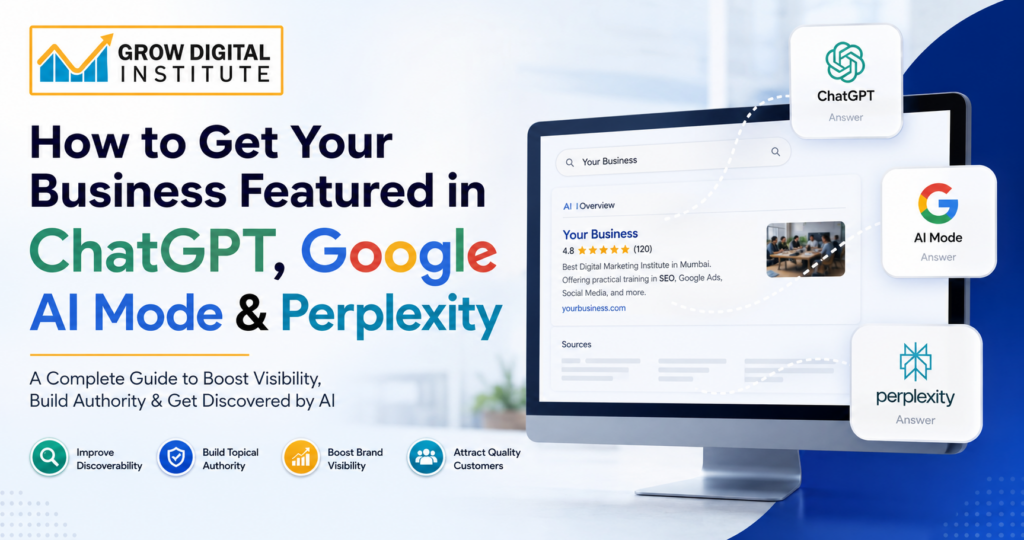
How to Get Your Business Featured in ChatGPT, Google AI Mode & Perplexity
Search is changing.
For years, businesses focused on one primary goal: ranking on Google.
Today, customers are increasingly using AI-powered search experiences to research businesses, compare products, find services and make purchasing decisions. Instead of searching through multiple pages, users can ask a complete question and receive an AI-generated answer with supporting information and links.
Platforms such as ChatGPT, Google AI Mode and Perplexity are changing how people discover information online.
This creates a new opportunity for businesses: becoming visible not only in traditional search results but also in AI-generated search experiences.
But can you actually make your business appear in ChatGPT, Google AI Mode or Perplexity?
There is no guaranteed shortcut or special technique that automatically places a business in AI responses. Instead, businesses need to build strong digital visibility through SEO, helpful content, topical authority, trustworthy information and Generative Engine Optimization (GEO).
In this guide, we explain how businesses can improve their chances of being discovered, understood and referenced by AI-powered search platforms.
What Is AI Search?

AI search uses artificial intelligence to understand a user’s question, retrieve relevant information and generate a conversational response.
Traditional search generally provides a list of links. AI search can understand a more detailed question and combine information from multiple sources to provide an answer.
For example, instead of searching:
“Best digital marketing institute Mumbai”
a user might ask:
“Which digital marketing institutes in Mumbai offer practical training, AI modules, live projects and placement support?”
AI-powered search can break a complex query into multiple related searches and identify information from different web sources.
Google explains that AI Mode can use a query fan-out approach, where related searches are performed across different subtopics before information is combined into a response.
This means your business website needs to provide enough useful, clear and trustworthy information for AI systems to understand what your business offers.
Why AI Search Visibility Matters for Businesses
People don’t always search for a brand by name.
They may search for:
- Best digital marketing institute in Mumbai
- Best SEO agency for small business
- Digital marketing course with placement
- Best spa in Mumbai for couples
- Affordable website development company
- Best Google Ads agency near me
If your website provides useful information around these questions, it can become part of the information ecosystem that AI-powered search uses to answer users.
This is where GEO becomes important.
If you are new to the concept, you can first understand how GEO is changing SEO and AI search visibility as part of your broader search strategy.
GEO does not replace SEO. Instead, it builds upon strong SEO fundamentals and focuses on making information easier for AI systems to understand, retrieve and use.
1. Build a Strong SEO Foundation
The first step to get your business featured in ChatGPT and other AI search experiences is surprisingly simple:
Build a technically sound, useful website.
Google specifically states that existing SEO best practices continue to apply to AI Overviews and AI Mode. Pages need to be crawlable, indexable and eligible to appear in normal Google Search.
Your website should therefore have:
- Search-friendly URLs
- Proper title tags
- Relevant meta descriptions
- Logical heading structure
- Mobile-friendly design
- Fast page loading
- Internal linking
- Crawlable content
- Proper indexing
- Helpful, original content
- Clear business information
Don’t think of GEO as a replacement for SEO.
Think of it as the next layer of your search strategy.
Your complete SEO strategy for higher Google rankings should form the foundation before you start focusing heavily on AI search visibility.
2. Create Content That Directly Answers Questions
AI search is built around questions.
Therefore, businesses should stop creating content only around keywords and start creating content around real customer problems and questions.
For example, instead of creating an article titled:
“Digital Marketing Services”
a business could create:
“How Much Does Digital Marketing Cost for a Small Business in Mumbai?”
Other useful formats include:
- What is digital marketing?
- How does SEO help small businesses?
- How much does Google Ads cost?
- Which social media platform is best for businesses?
- How long does SEO take?
- What should a business include in a digital marketing strategy?
- SEO vs Google Ads: Which is better?
This approach supports both SEO and AEO (Answer Engine Optimization).
The goal is to make your content useful enough that search engines and AI systems can easily identify the answer to a user’s question.
3. Build Topical Authority
One blog post is rarely enough to establish strong authority around a subject.
Instead, create a topic cluster.
For example, a digital marketing institute could build a content cluster around AI search:
Pillar Topic:
How to Get Your Business Featured in ChatGPT, Google AI Mode & Perplexity
Supporting topics could include:
- GEO vs SEO
- What is Generative Engine Optimization?
- How to Optimize Content for AI Search
- SEO vs AEO vs GEO
- How ChatGPT Search Works
- Google AI Mode Explained
- Best GEO Strategies for Small Businesses
- How to Build Topical Authority
These articles should be connected through relevant internal links.
For example, when discussing GEO vs SEO, link naturally to your upcoming SEO vs GEO vs AEO guide.
This creates a connected knowledge structure rather than a collection of unrelated blogs.
4. Make Your Business Information Consistent
AI systems need to understand who you are, what you offer and where you operate.
Your business information should therefore remain consistent across your:
- Website
- Google Business Profile
- Social media profiles
- Business directories
- Review platforms
- Industry websites
For a local business, clearly mention:
Business name + service + location + relevant expertise
For example:
Grow Digital Institute is a digital marketing institute in Mumbai offering practical training in SEO, Google Ads, social media marketing, AI tools, WordPress and other digital marketing skills.
Your website currently positions Grow Digital Institute around practical digital marketing training in Mumbai, including SEO, Google Ads, social media, AI tools and WordPress.
Clear information makes it easier for users—and search systems—to understand your business entity.
5. Create Location-Specific Content
For local businesses, location matters.
If you want to improve your chances of appearing for searches such as:
“digital marketing institute in Mumbai”
don’t simply repeat the keyword throughout your website.
Instead, develop genuinely useful local content.
For example:
- Digital Marketing Courses in Mumbai
- Digital Marketing Courses in Borivali
- Digital Marketing Courses in Andheri
- Best Digital Marketing Course in Mumbai
- Digital Marketing Course Fees in Mumbai
- Digital Marketing Career Opportunities in Mumbai
Your existing blog already contains Mumbai, Borivali and Andheri-focused content, giving you an opportunity to strengthen this local topical cluster further.
The important point is to avoid creating multiple pages that say essentially the same thing.
Each location page should provide unique and useful information.
6. Demonstrate Experience and Expertise
AI systems are increasingly designed to surface useful and reliable information.
That means generic content is unlikely to be a strong long-term strategy.
Show real expertise by including:
- Author information
- Professional experience
- Case studies
- Original examples
- Data
- Industry observations
- Practical recommendations
- Screenshots where appropriate
- First-hand experience
- References to authoritative sources
For an educational institute, this could mean demonstrating actual training experience, live projects, practical assignments, industry tools and examples.
For an agency, it could mean publishing case studies showing how a campaign was planned and optimized.
The more evidence you provide, the easier it is for people to trust your content.
7. Optimize Content for Conversational Queries
People speak differently to AI systems than they type into traditional search engines.
Instead of:
“GEO definition”
they may ask:
“What is GEO and how can I use it to make my business visible in ChatGPT?”
Your content should therefore include natural-language questions and direct answers.
Use headings such as:
What is GEO?
How does ChatGPT Search find information?
Can a small business appear in AI search results?
How can I optimize my website for AI search?
Does SEO still matter for Google AI Mode?
This structure improves readability while also creating strong AEO opportunities.
8. Make Important Information Easy to Find
Don’t hide important business information deep inside your website.
Your website should clearly communicate:
- What you do
- Who you serve
- Where you operate
- Your services
- Your products
- Your expertise
- Contact information
- Frequently asked questions
Google’s guidance specifically recommends making important content available in textual form and ensuring that important content is easily discoverable through internal links.
This is another reason why internal linking is important for both traditional SEO and broader AI search visibility.
9. Optimize Your Google Business Profile
For local businesses, your website is only one part of your online presence.
Your Google Business Profile should contain accurate:
- Business name
- Address
- Phone number
- Website
- Business category
- Services
- Opening hours
- Photos
- Reviews
Keep the information updated and consistent.
Google also recommends keeping Business Profile information up to date when working toward visibility across its AI search experiences.
For a business targeting searches such as “digital marketing institute in Mumbai”, local SEO should therefore work alongside website SEO and GEO.
10. Earn Mentions and References From Other Websites
Your own website is not the only source of authority.
Third-party mentions can help establish your business’s broader online presence.
Consider earning legitimate mentions through:
- Industry publications
- Local business websites
- Educational portals
- Interviews
- Guest contributions
- Business directories
- Professional associations
- PR coverage
However, don’t approach this as simply collecting backlinks.
The goal should be to build a recognizable and trustworthy digital entity.
Quality and relevance matter more than creating hundreds of low-quality links.
11. Don’t Try to “Hack” AI Search
One of the biggest misconceptions about GEO is that there is a secret formula that guarantees a business will appear in ChatGPT, Google AI Mode or Perplexity.
There isn’t.
Google explicitly states that there are no additional technical requirements or special schema requirements specifically for appearing in AI Overviews or AI Mode.
Similarly, ChatGPT says that there is no way to guarantee top placement in ChatGPT Search. Websites should instead allow OAI-Searchbot to crawl their content and maintain relevant, reliable information.
So avoid tactics such as:
- Keyword stuffing
- Hidden text
- Fake reviews
- AI-generated spam
- Duplicate location pages
- Manipulative backlinks
- Writing content only for AI bots
The long-term strategy is much simpler:
Create useful information that deserves to be discovered.
12. Measure Your AI Search Visibility
AI search visibility shouldn’t be treated as a one-time task.
Monitor:
- Organic traffic
- Search impressions
- Click-through rate
- Branded searches
- Non-branded searches
- Leads
- Conversion rates
- Referral traffic
- Ranking keywords
- Featured snippets
- AI search appearances where observable
Google states that traffic from AI Overviews and AI Mode is included in the overall Web search data within Search Console.
You can therefore combine Search Console and Analytics data to understand whether your content is attracting qualified visitors.
Also test your business manually.
Search different variations of questions related to your:
Business + service + location + problem
For example:
“Best digital marketing institute in Mumbai for practical training”
“Where can I learn Google Ads in Mumbai?”
“Best digital marketing course in Borivali?”
This gives you a practical view of how your digital presence is being discovered.
Can You Guarantee That Your Business Will Appear in ChatGPT, Google AI Mode or Perplexity?
No.
AI search results are dynamic and can change based on the query, location, available information, search systems and other factors.
Google states that meeting its requirements and following best practices does not guarantee that a page will be crawled, indexed or served.
The right objective is therefore not:
“How do I force ChatGPT to mention my business?”
Instead, ask:
“How do I build the most useful, trustworthy and discoverable online presence for my target audience?”
That shift in mindset is the foundation of effective GEO.
SEO + AEO + GEO: The Future of Search Visibility
The future isn’t about choosing between SEO, AEO and GEO.
Businesses should think of them as connected strategies.
SEO helps search engines discover and understand your website.
AEO helps your content provide direct answers to user questions.
GEO focuses on improving your visibility across generative AI search experiences.
Together, they create a stronger digital presence.
If you want to understand how modern search optimization is evolving, explore our complete SEO guide for ranking on Google and continue building your knowledge around AI-powered search.
Final Thoughts
Getting your business featured in ChatGPT, Google AI Mode and Perplexity isn’t about finding a shortcut.
It is about building a strong digital foundation.
Start with technical SEO. Create genuinely useful content. Answer real customer questions. Build topical authority. Strengthen your local presence. Keep your business information consistent. Earn relevant mentions. And make your website easy for both people and search systems to understand.
Most importantly, remember that GEO does not replace SEO.
The businesses most likely to benefit from the changing search landscape will be those that consistently demonstrate relevance, expertise, usefulness and trust across their digital presence.
For students and professionals who want to learn these strategies practically, Grow Digital Institute’s Advanced Digital Marketing Course covers key areas such as SEO, Google Ads, social media marketing, AI tools, WordPress and other practical digital marketing skills.
Quick Answer: How Do I Get My Business Featured in AI Search?
Build a technically sound website, publish helpful and authoritative content, answer customer questions clearly, strengthen local SEO, maintain consistent business information, build topical authority and make your content easy for search engines and AI systems to discover and understand. There is no guaranteed shortcut to appear in ChatGPT, Google AI Mode or Perplexity.